The Hidden FEAR That Runs Your Life
"What are you always running from?" The FEAR model in ACT — Fusion, Evaluation, Avoidance and Reason-giving — explains how our fears quietly shape the way we live, and points to gentler ways to face …


"What are you always running from?" The FEAR model in ACT — Fusion, Evaluation, Avoidance and Reason-giving — explains how our fears quietly shape the way we live, and points to gentler ways to face …

"What are you always running from?" It is an unsettling question, but a worthwhile one to sit with. Every one of us carries fears we would rather not face — fears rooted in past trauma, in worry about the future, or in the uncertainty of the present moment. When confronted with them, we so often choose to run, finding all sorts of ways to paper over them. Yet avoidance never resolves the problem; if anything, it binds us tighter, like a knot we strain at with all our might but still cannot work loose.
The FEAR model in ACT (Acceptance and Commitment Therapy) is precisely the tool that helps us understand how these fears come to shape our lives. The FEAR model comprises four core elements: Fusion, Evaluation, Avoidance and Reason-giving. These elements work on one another, together forming the pattern of how we respond to fear.
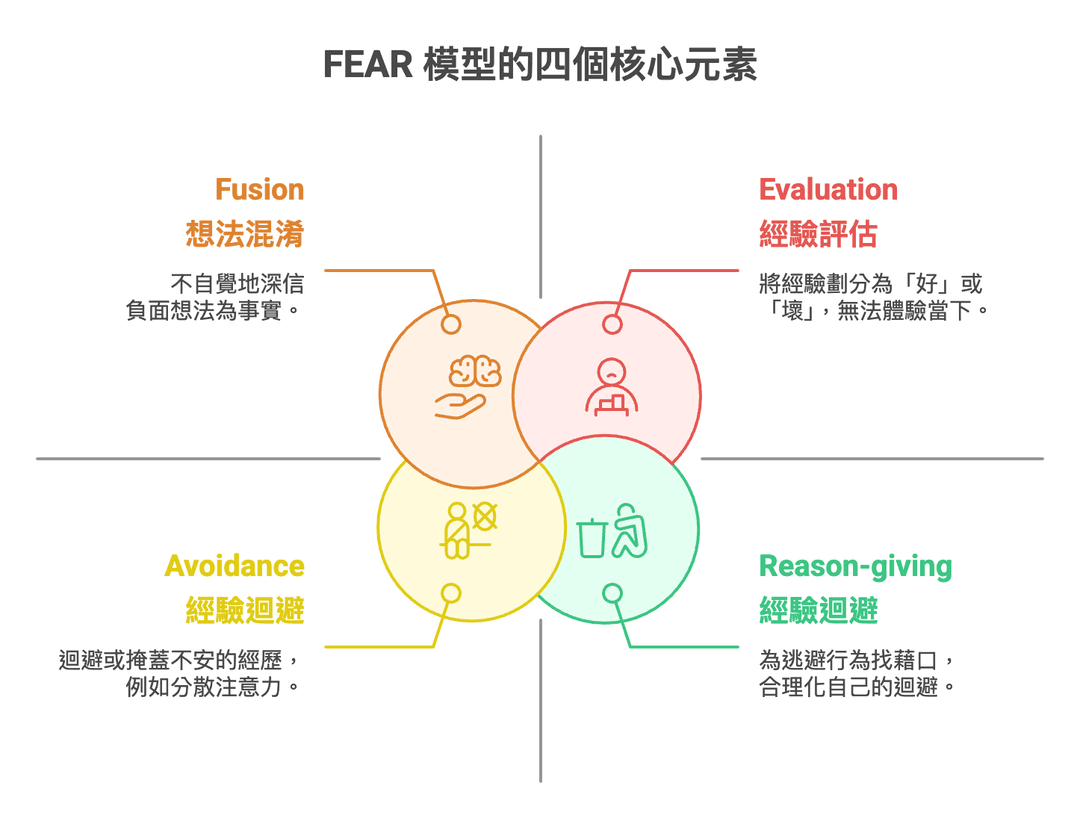
"I'll never succeed." "I'm not worth loving." You may have replayed thoughts like these countless times in your mind — but have you ever asked yourself: do these thoughts really reflect reality? Fusion means taking the thoughts in our heads as though they were facts, believing them without a shadow of a doubt. This kind of fusion leaves us unable to tell thought from reality, so that we treat these thoughts as unshakeable truths.
When we turn a negative thought over and over in our minds, that thought only feels more and more real. We react to it with intense emotion, and may even act on it. If, for instance, you keep thinking "I'll never succeed", you may lose all motivation for your work, and gradually sink into the abyss of giving up on yourself.
This kind of fusion does not only trap us in a cycle of negative emotion; it also shapes our behaviour and our decisions. We may make unreasonable choices because of these thoughts, and even miss out on important opportunities. In this way, our lives grow narrower and narrower, more and more confined.
To find our way out of this maze, we need to learn to tell thought from reality. There are psychological techniques that can help us recognise that these thoughts are merely voices in our heads, not reality itself. We can try, for example, to see these thoughts as scenes in a film, rather than as something we are truly living through. In this way, we can hold these thoughts apart from reality, and so lessen their grip on us.
"This feels bad — I need to get rid of it as quickly as I can." Is this something you often say to yourself in your head? Evaluation means passing judgement on our own experiences, sorting them into "good" or "bad". This kind of judgement keeps us from truly experiencing the present moment; instead, we fix our attention on those experiences we have judged "bad", continually magnifying the original anxiety, and in the end breeding still more fear.
When we pass judgement on our own experiences, we react to them with intense emotion. If, for example, you feel that a certain sensation is "bad", you may want to get rid of it as quickly as possible. This emotional reaction intensifies our fear and anxiety around these experiences, making them harder still to face.
And yet these judgements are often based on our subjective views, not on objective fact. We may form a bias against certain experiences because of past events or social and cultural influences, and so judge them negatively. In this way, we miss the value and meaning that may lie within these experiences.
To loosen these tangled bonds, we need to learn to embrace the present. There are mindfulness techniques that can help us focus on the present moment, rather than passing judgement on these experiences. We can try, for instance, to focus our attention on our breathing, or to take in the surroundings and sounds of the present moment. In this way, we can experience the present more fully, instead of being hemmed in by these judgements.
"I don't want to deal with this problem — I'll do something else first." Does this sound familiar? Avoidance means choosing to escape the experiences that make us uneasy. We may use all sorts of ways to distract ourselves, or turn to other activities to cover up that unease.
Avoidance lets problems pile up like a mountain, and lets unresolved pain spread like wildfire. When we choose to avoid these experiences, we cannot truly face them, and so we cannot find a way to solve the problem. This makes these experiences ever harder to cope with, and they may come to weigh on our lives more heavily still.
To overcome experiential avoidance, we need to learn to face challenges with courage. Exposure-based techniques can help us face these experiences little by little. We can try, for example, to expose ourselves to the situations that make us uneasy, drawing closer to the heart of our fear time and again, and practising relaxation techniques within them. In this way, we can gradually lessen our fear of these experiences, and so cope with them better.
"I can't deal with this problem because I'm too busy." "I can't change this habit, because I've done it this way for so long." You may have used these excuses countless times, dressing up your behaviour to look perfectly justified. But do they really help you solve the problem? Reason-giving means finding all kinds of excuses for our avoidant behaviour. When the mind floats up reason after reason to put things off, fear marches straight in unchecked, and goes on eating away at the drive we once had.
When we find all sorts of excuses for our avoidant behaviour, we cannot truly face these problems. We may use all manner of reasons to explain why we cannot change, but these reasons are often just excuses that let us go on avoiding. They make us miss the starting point of facing our difficulties, and miss every possible breakthrough. In this way, we miss important opportunities, and may even feel dissatisfied with our own lives.
To break through these excuses, we need to learn to take action. Behaviour-based techniques can help us overcome these excuses and truly face these problems. We can try, for instance, to write these excuses down, and analyse the reasonableness of each one in turn. In this way, we can better recognise how these excuses shape our behaviour, and so take action more effectively.
Understanding the FEAR model in ACT does not only help us understand our own fears better and pass through the dark mist; it also helps us find more effective ways to respond to those fears. If you feel helpless in the face of these fears, or would like to understand more deeply how to respond to them, it is worth considering professional help. TreeholeHK's psychotherapy service can offer you professional psychological support, helping you respond to these fears better and find more effective ways to pursue the life you truly want. This kind of support can become one steady stepping stone after another, offering gentle guidance to those struggling within their fears, so that even when everything feels crushing, the possibility of a breakthrough is always there.
References:
Hayes, S. C., Luoma, J. B., Bond, F. W., Masuda, A., & Lillis, J. (2006). Acceptance and commitment therapy: Model, processes and outcomes. Behaviour Research and Therapy, 44(1), 1-25. https://doi.org/10.1016/j.brat.2005.06.006
Blackledge, J. T., & Hayes, S. C. (2001). Emotion regulation in acceptance and commitment therapy. Journal of Clinical Psychology, 57(2), 243-255. https://doi.org/10.1002/1097-4679(200102)57:2<243::AID-JCLP9>3.0.CO;2-X
Kashdan, T. B., Barrios, V., Forsyth, J. P., & Steger, M. F. (2006). Experiential avoidance as a generalized psychological vulnerability: Comparisons with coping and emotion regulation strategies. Behaviour Research and Therapy, 44(9), 1301-1320. https://doi.org/10.1016/j.brat.2005.10.003
Gillanders, D. T., Bolderston, H., Bond, F. W., Dempster, M., Flaxman, P. E., Campbell, L., … & Remington, B. (2014). The development and initial validation of the cognitive fusion questionnaire. Behavior Therapy, 45(1), 83-101. https://doi.org/10.1016/j.beth.2013.09.001
Levin, M. E., Hildebrandt, M. J., Lillis, J., & Hayes, S. C. (2012). The impact of treatment components suggested by the psychological flexibility model: A meta-analysis of laboratory-based component studies. Behavior Therapy, 43(4), 741-756. https://doi.org/10.1016/j.beth.2012.05.003
Su, Y.-H. (2016, December 7). Introduction to Acceptance and Commitment Therapy (ACT) [Taiwan]. Revised by the author, Clinical Psychologist Su Yi-Hsien.//contextualscience.org/blog/acceptance_and_commitment_therapy
Keep reading
Personal Growth
Personal Growth
Personal Growth



Comments
No comments yet — share your thoughts.