


We all lose our way: when life presses the "pause button"
Have you ever had this experience — everything in life looks fine, yet you suddenly feel busy without knowing what you are busy for?
That state where your direction vanishes, your drive fades, and even joy turns blurry, is what we call being "lost".
Psychology calls this feeling a meaning crisis. When we temporarily can no longer find coherence and meaning in life, confusion and anxiety follow (Heine et al., 2006).
But being lost does not mean you have done something wrong. It is life reminding you: "It is time to redraw your inner map."
Why do we feel more lost the harder we try?
1) Too many choices, paradoxically more anxiety
Modern life offers us too many choices — career, relationships, lifestyle, all flickering before our eyes.
Psychologist Barry Schwartz (2004) called this phenomenon The Paradox of Choice: the more options we have, the lower our satisfaction tends to be, because we are more likely to doubt whether we chose wrongly.
The result is that the harder we try to find "the right direction", the more easily we sink into confusion.
2) Social media magnifies comparison
As we scroll through our phones, we see other people's "perfect lives", forgetting that they are only edited highlights.
Research shows that the social comparison effect can erode self-esteem and clarity (Vogel et al., 2014). When we keep fixing our attention on other people's progress, it is hard not to feel we are always falling behind.
3) Changes in identity make us lose our centre
Psychologist Erik Erikson (1968) noted that everyone goes through an identity crisis.
When our roles shift — from student to working professional, from free-spirited to settled, from single to entering a relationship — our inner self also needs time to find its footing again. Being lost is, in fact, a natural response to inner adjustment.
Being lost is not a step backward, but a life "upgrade"
We often mistakenly assume that "lost = failure", but psychology tells us this is, on the contrary, a prelude to growth.
According to Robert Kegan's (1994) Theory of Adult Development, every instance of psychological growth involves the collapse of old beliefs and the rebuilding of new perspectives. This process is naturally accompanied by confusion and uncertainty.
In other words, the lost version of you is actually evolving.
When old values no longer fit your present life, your inner system automatically updates itself. That "stuck" feeling is not an obstacle, but a reminder — the next chapter of your life is preparing to begin.
4 direction-finding exercises psychology offers to those who feel lost
1) Allow yourself to "not know"
Society teaches us to have goals and have plans, but it is actually okay to "not know".
Research suggests that allowing yourself to sit with uncertainty can enhance psychological flexibility and creativity (Sweeny et al., 2015).
When you let go of the anxiety of rushing to find answers, the noise within slowly turns into a clear echo.
2) Reconnect with your own values
True direction is not given from the outside; it grows from within.
Schwartz (1992) found that people who are clear about the values they hold dear (such as freedom, honesty, growth) find it easier to make consistent choices when facing adversity.
Ask yourself: "What kind of person do I want to become? What do I value?" The answers will guide you out of life's fog.
3) Let go of comparison and focus on your own rhythm
Other people have their own time zone; you have your own journey.
Practise self-compassion (self-compassion), replacing self-blame with understanding (Neff, 2003). Note down a little progress every day — it does not need to be much; as long as you are a bit closer to yourself than you were yesterday, that is enough.
4) Action is what helps you find direction
Overthinking only deepens the confusion. Action, on the other hand, can bring clarity.
Kolb's (1984) Experiential Learning points out that it is through the cycle of action–reflection–adjustment that a person truly grows.
Try doing small things — sign up for a class, change a habit, write down the thoughts on your mind — and a sense of direction will surface naturally through action.
The art of living with uncertainty: let the "unknown" become your teacher
When we stop resisting being lost, it stops being so frightening.
Psychologist Viktor Frankl (1959) wrote in Man's Search for Meaning: "When life has no meaning, a person can still choose to give it meaning."
Perhaps you are still in the fog right now, but being lost does not mean being adrift.
It is simply your soul whispering: "Are you ready to explore a new version of yourself?"
You do not need to see the whole path clearly at once; as long as you are willing to take the next step, the direction will gradually reveal itself.
In closing: being lost is life's invitation to grow
We can never avoid being lost forever, but we can choose how to live with it.
A truly mature person is not someone who is always clear about where they are going, but someone who is willing to keep walking even when they cannot see clearly.
The next time you feel "I don't know what I am doing", please remember —
that does not mean you are adrift; it means you are facing life honestly.
The fog does not need to clear; you only have to keep walking, and it will lift on its own.
From lost to awakened: MindForest walks with you back to your inner sense of direction
When life leaves you feeling anxious and confused, please remember that being lost does not mean failure — it is a journey of getting to know yourself anew.
MindForest App helps you rediscover your heart's rhythm and strength amid the confusion.
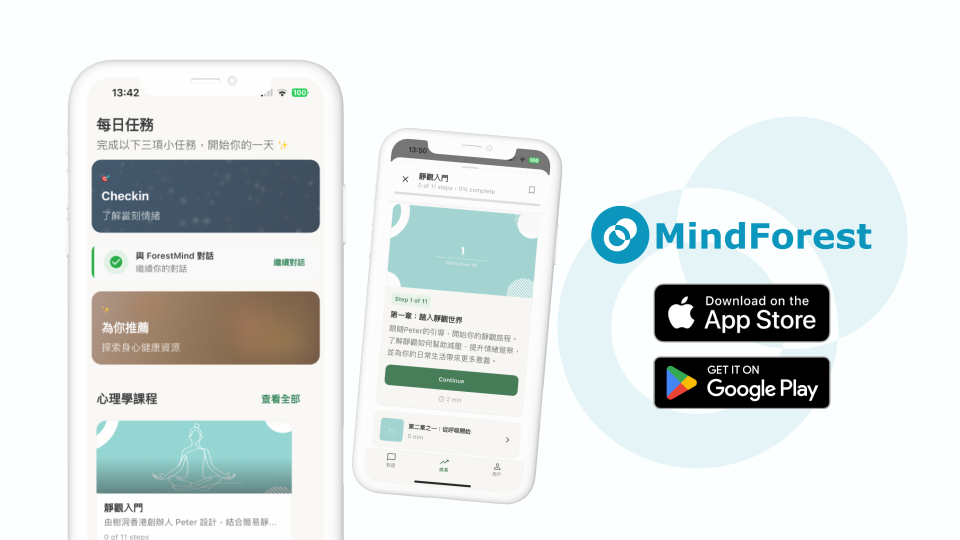
1️⃣ Awareness stage — ForestMind AI walks with you through the fog
Through gentle conversation and questions, AI helps you recognise your emotions and see the real needs behind your confusion.

2️⃣ Understanding stage — the Insight Journal becomes a map of your mind
By writing down your thoughts and feelings, your tangled ideas become clear, and you learn to sort out your direction through words.

3️⃣ Growth stage — psychological assessments explore your inner drive
Understand your personality and values, find the source of energy that propels you, and locate yourself anew amid the confusion.

? Download MindForest App now and begin your journey of inner awakening.
☁️ You can also try the web version.
References
Erikson, E. H. (1968). Identity: Youth and crisis. New York: W. W. Norton.
Frankl, V. E. (1959). Man's search for meaning. Boston: Beacon Press.
Heine, S. J., Proulx, T., & Vohs, K. D. (2006). The meaning maintenance model: On the coherence of social motivations. Personality and Social Psychology Review, 10(2), 88–110.
Neff, K. D. (2003). Self-compassion: An alternative conceptualization of a healthy attitude toward oneself. Self and Identity, 2(2), 85–101.
Schwartz, B. (2004). The paradox of choice: Why more is less. New York: Harper Perennial.
Schwartz, S. H. (1992). Universals in the content and structure of values: Theoretical advances and empirical tests in 20 countries. In M. P. Zanna (Ed.), Advances in experimental social psychology, Vol. 25, pp. 1–65). Academic Press. https://doi.org/10.1016/S0065-2601(08)60281-6
Vogel, E. A., Rose, J. P., Roberts, L. R., & Eckles, K. (2014). Social comparison, social media, and self-esteem. Psychology of Popular Media Culture, 3(4), 206–222.*



Comments
No comments yet — share your thoughts.