

Wherever there are people, you'll sooner or later run into a few who are plainly of very low ability yet think the world of themselves. Their confidence is so emphatic it makes your jaw drop, and you can't help wondering where on earth it comes from. Today we'll look at a famous psychological cognitive bias (Cognitive Bias) called the Dunning–Kruger Effect (DKE for short). DKE points out that people of low ability tend to greatly overestimate their own competence; the genuinely skilled, meanwhile, can see that there is always someone better, and so are rather less sure of themselves.
Why does this happen? One explanation is that people generally have a tendency to overrate their own abilities (Self-Serving Bias) — for instance, an earlier study asked Americans to rate their own driving skill, and most of them reckoned they were above average. But this tendency alone can't account for the gap between people who simply feel good about themselves and genuine experts. Dunning and Kruger, the psychologists who named this phenomenon, argued that beginners overestimate their ability because they lack the knowledge to gauge the average standard in a field in the first place. It's like a teenager who reads a few popular-science books and assumes that's the whole of science, with no idea how a real scientist actually does science. It's what we often mean by "a little knowledge is a dangerous thing" or seeing the sky from the bottom of a well.
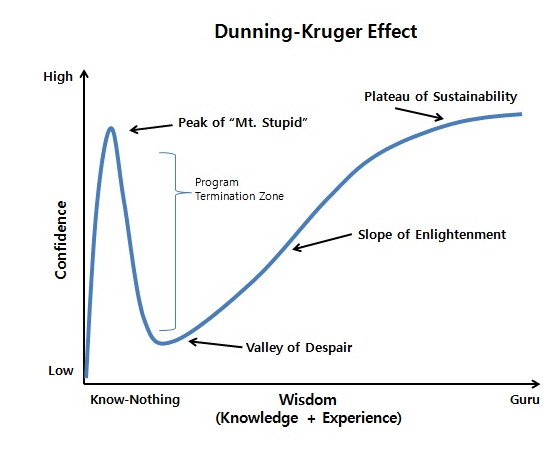 This intriguing phenomenon can even be plotted on a graph. The DK curve shows that when you first dip into a field, your confidence climbs all the way up to "Mt. Stupid". As your understanding grows, you suddenly realise just how much more there is to know — and how little you really know yourself. Happily, with time and accumulated experience, confidence and real ability gradually rise to roughly proportionate levels.
Seen this way, knowing very little while being rather pleased with yourself isn't such a big problem, because as long as you keep an open mind and keep learning, your ability will steadily catch up. As Dunning and Kruger put it, overconfidence stems from lacking the knowledge to recognise what a genuine expert's level looks like. As long as you don't close yourself off and keep taking in other views, you'll always make it past Mt. Stupid. The real danger is believing you're a guru of your generation, turning a deaf ear to sound criticism and dissent, or even sneering at it.
I myself sometimes climb Mt. Stupid when I'm learning something new. A few years ago, for example, when I first took up philosophy, I had a kind of confidence I couldn't even account for; now I'm slowly clawing my way up out of the Valley of Despair. In my personal experience, the people who anoint themselves gurus and speak about everything with absolute certainty are mostly not guru-grade at all. The ones with real ability, by contrast, will use their command of the subject to show you just how complex the problem is, and will admit that even they are sometimes at a loss.
When even the great philosopher Socrates said, "The only thing I know is that I know nothing," it leaves me genuinely in awe of how some people can crown themselves master without batting an eye — a phenomenon that seems especially common in the pseudoscience crowd, among the so-called "spiritual" set, the "Law of Attraction" believers, the "animal communicators", and the "(pseudo) psychotherapy" world. At times like these, I can only count myself lucky to have met a few profoundly capable yet deeply humble mentors, who remind me of what real learning worth pursuing looks like.
Want to understand yourself more deeply? MindForest — a self-exploration app that blends psychology with AI, helping you explore your inner world and manage your emotions anytime, anywhere.


Comments
No comments yet — share your thoughts.