Why Mindfulness Makes Better Leaders
Major companies abroad now build mindfulness into leadership training — and the results speak for themselves. Here is why, and the three workplace skills it sharpens.



Major companies abroad now build mindfulness into leadership training — and the results speak for themselves. Here is why, and the three workplace skills it sharpens.
In short: mindfulness (in English: Mindfulness) is a mind-training tool with substantial backing from modern psychology research. Its core approach is cultivating an individual's awareness of their own thoughts and emotions, allowing the mind to think more clearly and to better manage stress and emotion.
Mindfulness (Mindfulness) has taken off in Hong Kong in recent years. Overseas, many large enterprises have long built mindfulness into their leadership training, to remarkable effect.
For the American insurance giant Aetna, mindfulness leadership training is no optional leisure activity — it is core business strategy. The reason is simple: mindfulness genuinely raises team productivity and cuts staffing costs. According to Aetna's internal survey report on corporate mindfulness training, it raised annual output value by an average of over HK$20,000 per employee — which, across 100 employees, amounts to a full two million dollars in value for the company. Employees' stress levels also fell by an average of 33%, further reducing talent attrition and medical costs. So why is mindfulness capable of all this? Let us look at how mindfulness relates to leadership ability at work:
What qualities does a good sales leader need? Many people assume they must be eloquent and quick-tongued, but according to new research, the sales reps with the highest close rates spend only 40% of a sales call talking. The more they talk, the lower the close rate: the worst-performing reps spend around 66% of the time talking — roughly a "two lines from me, one from you" ratio.
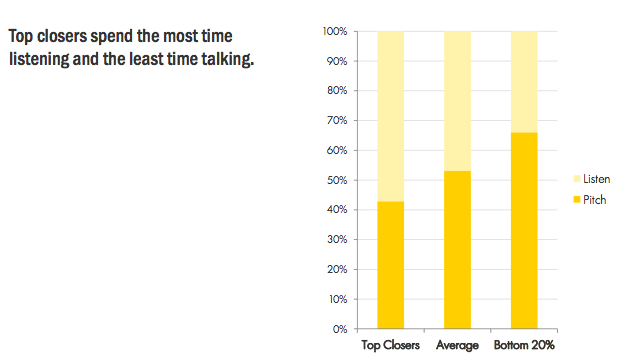
This research amply demonstrates the importance of listening. Fundamentally, everyone longs to be heard and understood. Yet if both sides of a conversation only care about being heard, no one is left listening. Mindful communication lets us understand the other person with a non-judgemental attitude (Non-judgemental). The person who feels understood feels respected, and naturally becomes more open and candid about expressing their own needs — strengthening the long-term relationship between both parties.

Mindfulness is a mental state — a state of being fully aware of the present moment. In a mindful state, we observe the sensations of the present moment closely. For example, one mindfulness exercise is eating a raisin (Guided recordings: Mindful Living > Eating — give it a try), during which we observe every aspect of the raisin as a sommelier might, such as its texture, sheen and aroma, in order to cultivate the ability to attend to detail.
This ability can extend to every aspect of work. A project manager, for instance, needs to inspect every detail of a product closely; mindfulness can help them notice details that are not obvious but may well be crucial. At the same time, leaders need to understand how their team members feel and think, and keen powers of observation can help a manager read the situation and build deeper communication with their reports.
There is even a documented case: Matthieu Ricard — a practitioner who has trained in mindfulness over the long term — became, without any other special training, an expert at distinguishing microexpressions (Microexpression).
One of the most important effects of mindfulness is changing one's attitude towards adversity. People sometimes shy away from difficulty and take the easy route, whereas mindfulness lets us rise to the challenge instead. The difference between these two attitudes is precisely what separates success from failure. As the saying goes, "nothing ventured, nothing gained" — anything easy to do is probably already being done by your competitors. So without the courage and resolve to push through difficulty, a team simply cannot build a good product.

Why can mindfulness leadership training change one's attitude towards adversity? It is because mindfulness makes us less afraid of negative emotions. Through mindfulness training, we learn to receive negative emotions with equanimity, letting them come naturally and go naturally. When we are no longer afraid of negative emotions, we naturally stop avoiding difficulty so much — because the reason we avoid difficulty is often the negative emotions that accompany it. Take an example: when a company wants to launch a promising new project, the pioneering founder always has to face the tension and apprehension that uncertainty brings. If team members simply avoid these emotions, perhaps no one will be willing to take the new project on. Conversely, if apprehension is seen as an inevitable part of a new project, the whole matter looks quite different.
Mindfulness is not only individual practice — when an entire management team learns it together, the effect multiplies. TreeholeHK's corporate training offers mindfulness leadership workshops, helping management stay clear-headed under pressure. Want your team to experience it together? Our team-building activities also weave in mindfulness elements, letting colleagues build rapport in a relaxed setting.



Comments
No comments yet — share your thoughts.