

In the face of fierce competition in today's business environment, many company owners look for ways to raise their staff's efficiency and output — running activities such as personnel training and team-building for their front-line employees, sharpening their working efficiency and resilience under pressure, and training them to become "supertaskers" capable of "multi-tasking". Yet when owners or managers grumble that "the staff are difficult to manage and the company is poorly run", they often overlook the fact that their own position carries an advantage of its own — an advantage that can effectively boost employees' morale and productivity without spending a single cent, creating a genuine win-win situation for employer and employee alike. That advantage is a manager's "attentive behaviours" towards their subordinates. In what follows, I will walk through a series of experiments designed by Dan Ariely, professor of psychology and behavioural economy at Duke University in the United States, to illustrate the "free" power of attentive behaviour itself.

Experiment One: Building Lego Models
This experiment split the participants into two separate conditions. In the first condition (condition A), researchers asked participants whether they were willing to assemble a Lego Bionicle model in exchange for a reward of US$3. Once a participant had finished building the first model, the researchers asked again whether they would like to build another model from the same series — while also noting that all the models would be dismantled once the experiment was over, and that each subsequent reward would fall by US$0.30. In this condition, participants on average agreed to build 11 models. In the second condition (condition B), participants were likewise invited to build models, and the rule for the diminishing reward was exactly the same as in the first condition. The only difference was that the researcher would dismantle the previous model right in front of the participant as they were building the next one, with the participant watching the whole process. The result? In this condition, participants built only 8 models on average.

Experiment Two: The Worksheet Exercise
This experiment involved three conditions. First, in the first condition (condition A), researchers handed out an English word searching worksheet, instructing participants to circle particular English words and to write their own name in a prominent place on the worksheet, with a cash reward given on completion.

Once a participant had completed the first worksheet, the researcher would look it over from top to bottom and then set the worksheet aside. The researcher would then ask again whether they were willing to complete the next worksheet, with each subsequent reward again diminishing. In the second condition (condition B), the nature of the task and the reward rule were exactly the same as in condition A, but there were two differences: (1) participants did not have to write their name; and (2) the researcher set the worksheet aside without looking it over. Finally, in the third condition (condition C), the nature of the task and the reward rule were identical to the previous two, with the one difference being that, each time a worksheet was completed, the researcher not only did not look at it but immediately fed it into a shredder to "destroy" it. So what were the results? In the first condition, the average reward at which participants completed one worksheet was 15 cents, indicating that they completed a greater number of worksheets. In the third condition, the average reward at which participants completed one worksheet was 30 cents, indicating that they completed fewer. Most notably, in the second condition the participants' average reward showed no significant difference from the third condition — proving that the effect of "ignoring" participants' "effort" was little different from outright "destroying" their output.

The Lesson of "The Myth of Sisyphus"
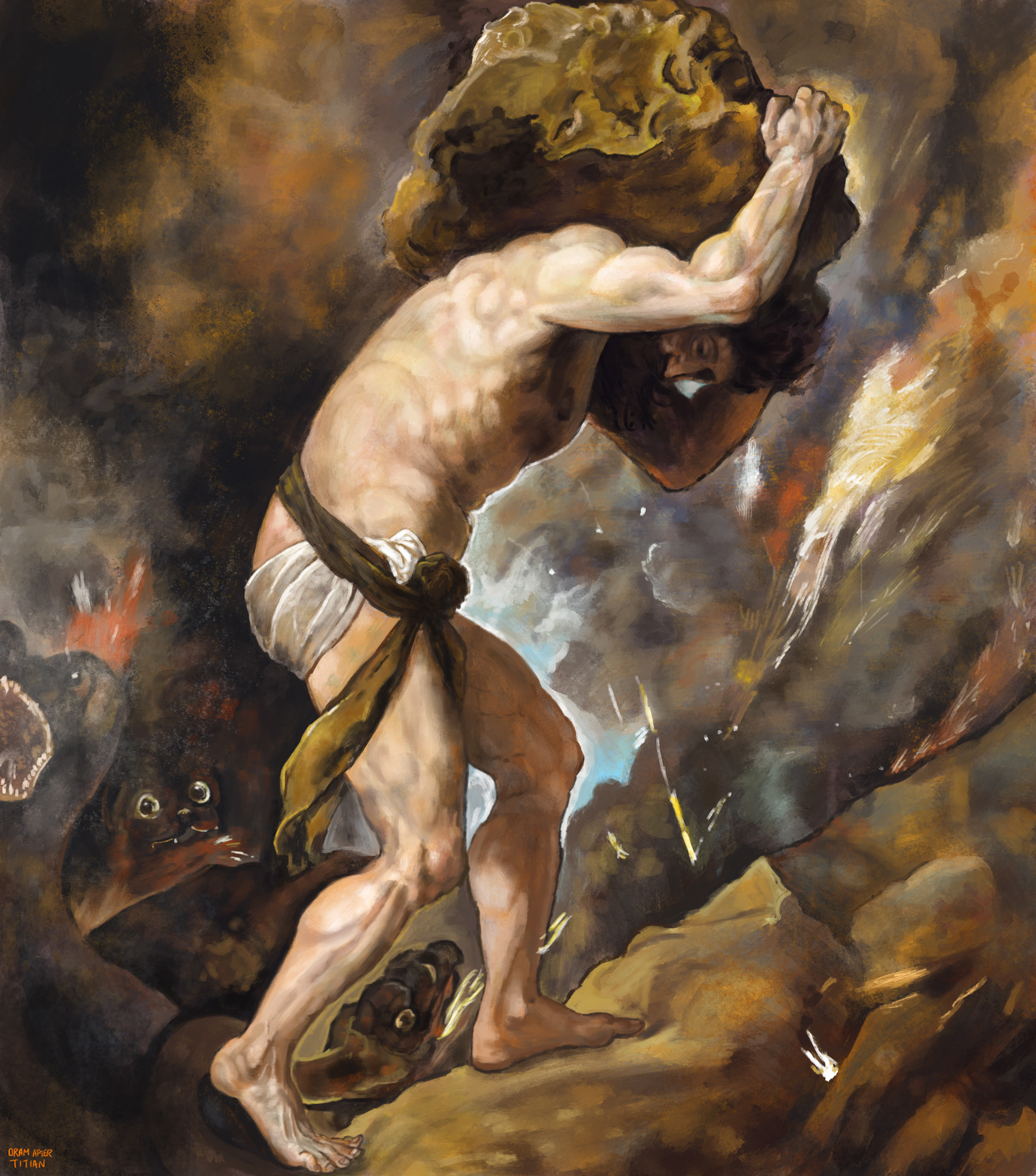
In ancient Greek myth, Sisyphus (Sisyphus) was condemned to eternal punishment for having angered Zeus: he had to push a boulder up a hill, and each time it reached the summit it would roll back down, forcing Sisyphus to start all over again. In Albert Camus's work The Myth of Sisyphus (The Myth of Sisyphus), Sisyphus's ceaseless and utterly meaningless toil becomes a metaphor for the state of modern working life. According to Dan Ariely, in the two experiments above, dismantling the models on the spot and shredding the worksheets are an expression of a kind of "Sisyphic condition". Even though participants could still earn a corresponding reward (and the arrangement of gradually diminishing sums was based on the economic law of demand and the law of diminishing marginal use value), once they came to realise that everything they were doing was for nothing — or that it would not earn anyone's "attentive behaviour" (loosely, "recognition" and "praise") — their motivation and enthusiasm to keep working were already greatly reduced. The dawning insight here is that, for a company's management, beyond adjusting salaries and offering rewards, paying attention to employees' work performance (or "taking it to heart") already has an effect in releasing employees' labour. Of course, viewed from a more pessimistic angle, merely turning a blind eye to employees' performance and output is already enough to deal a devastating blow to their morale.
Experiment Three: Origami and Its Implications
Participants were divided into two groups. In the first condition (condition A), researchers gave participants a set of origami instructions, with content that taught them in detail how to fold a simple yet "lifelike", pretty little animal. They then had both the person who did the folding and a separate bystander put a value on the finished piece — and the result was that the folder's valuation was about five times higher than the bystander's. In the other condition (condition B), the instructions the researchers handed out this time contained only brief hints, which not only made the folding process harder but also left the finished product tending to look "ugly"; both parties were then likewise invited to value it. The result? This time the folder's valuation was even higher, while the bystander's was lower, producing a wider gap in value.

The lesson the origami experiment brings out is that, to some degree, a suitable level of difficulty and a sense of autonomy can raise employees' sense of investment in their work and their enthusiasm. According to cognitive dissonance theory, because people have a tendency towards "consistency between word and deed" — or, to put it another way, we find it hard to accept the fact that "I spent a great deal of effort and time doing a meaningless piece of work" — once we have poured a large amount of effort into completing a given task, we tend to recognise that work as meaningful, in order to achieve consistency between cognition and behaviour.
Conclusion
In Hong Kong's workplaces there is a common saying that "employees" and "bosses" are forever standing on opposite sides of the line. For example, when "employees" think the workload is too heavy, "bosses" think it is too light. Conversely, when "employees" think the pay is too low, "bosses" feel they are already offering quite generous terms. In truth, if a company's management can skilfully apply psychological theory, a win-win situation is by no means just talk on paper. Of course, there are many other ways to improve a company's operational performance — for the details, please click here to browse our company's website.
Further Reading
Ariely, D., Kamenica, E., & Prelec, D. (2008). Man’s search for meaning: The case of Legos. Journal of Economic Behavior & Organization, 67(3-4), 671-677.
Comments
No comments yet — share your thoughts.