
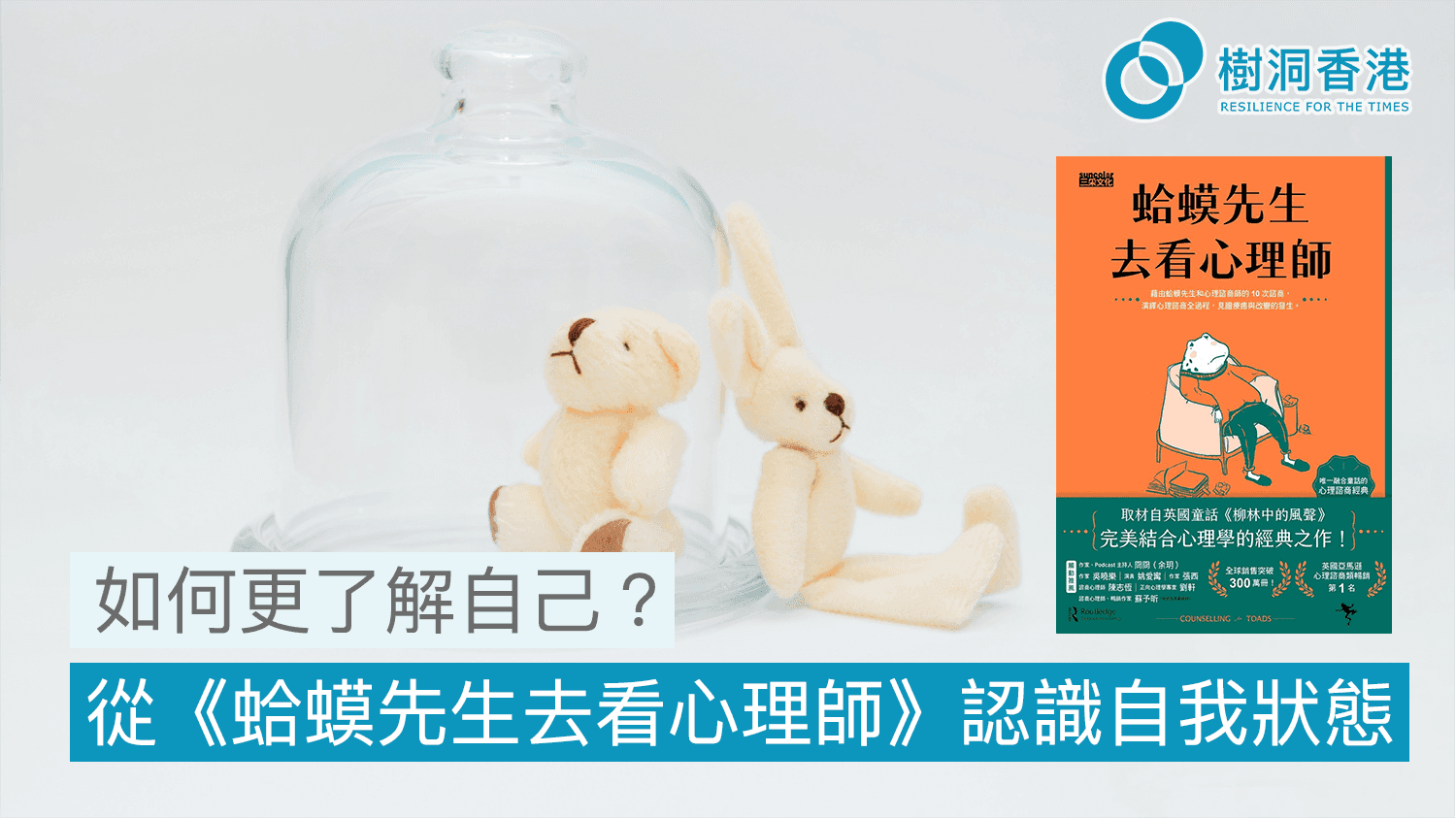
Whenever counselling or psychotherapy comes up, do certain stock impressions float into your mind? "It's for people with mental problems", "It's for the emotionally fragile", "It costs a fortune and who knows whether it even works"… In Counselling for Toads, the therapist Heron uses Structural Analysis — part of Transactional Analysis — to help Toad understand three different ego states, so that Toad can notice the thoughts and feelings he has about himself in each one. This allows Toad to develop his emotional intelligence and to communicate more effectively and happily with his friends, so that he can finally face his troubles and walk out of his low spell. This article introduces the three ego states in Transactional Analysis, in the hope that they give you a different angle on understanding yourself — and help you become someone who observes themselves and has the power to change for the better.
Transactional Analysis is a theory of personality proposed by the psychologist Eric Berne in the 1950s. It was first applied in counselling psychology, psychiatry and clinical psychology, and because its concepts are clear and easy to grasp, the business world, the education sector and many other fields have drawn on it widely. The theory of Transactional Analysis is divided into four parts: Structural Analysis, Transactional Analysis, Game Analysis, and Script Analysis. This article concentrates on Structural Analysis, which helps us understand the self. Readers interested in Transactional Analysis, Game Analysis and Script Analysis can read Eric Berne's classic Games People Play to learn more.

Using "Ego States" to Understand Yourself
When we try to understand ourselves, where do you begin? By looking back on moments from your childhood? By trying to make sense of what you think and feel right now, or why you keep repeating certain behaviours? The "ego states" Eric Berne proposed are the building blocks of every individual's personality: the Child Ego State, the Adult Ego State and the Parent Ego State. Berne noted that once the people he saw recognised and could distinguish these three ego states, their tone of voice, their posture, their facial expressions, the words they chose when speaking and the sentences those words formed all differed noticeably depending on which ego state they were in. Recognising your "ego states" can give you more clues, helping you see yourself from a broader angle — how you became the person you are today, and how you might move towards a better version of yourself.
The "Child Ego State"
As the Little Prince said: "All grown-ups were once children." Quite right — before we grow into adults we all pass through a stretch of childhood, growing up nurtured and guided by our parents. In Eric Berne's theory, the "Child Ego State" divides into the Free Child (Free Child Ego State) and the Adapted Child (Adapted Child Ego State). Why are there two different states of the child?
From the perspective of evolutionary psychology, our basic emotions — joy, sadness, fear and anger — are all innate. In the Free Child state, we express these emotions without the slightest concealment. For example, a child given a long-coveted toy will be over the moon; conversely, if they lose something important, such as a beloved family pet passing away, they will be heartbroken and burst into loud sobs. These reactions are all spontaneous — you could say the truest, most direct feelings are put on display entirely unfiltered.
So why do people develop the Adapted Child state? Picture this: when you first arrive in the world, you are extremely small and weak, unable even to control your own limbs, let alone feed yourself or find somewhere to sleep. At this point, two people far larger than you appear; they look after you, keep you fed and warm, and even spend time coaxing smiles out of you, playing with you, and teaching you what you need to know to survive in society. You could say that the first part of your life depends entirely on these two giants to supply everything you need, whether tangible or intangible. While these two giants shelter you from the wind and rain, they are also bearing some stress from the outside world; they have their own emotional ups and downs, and they cannot always embrace your every moment with the bearing of a "perfect parent". But you have nowhere to escape to, and the only thing you can do is adapt to their every mood — their joys, angers, sorrows and delights. Say, for instance, you want to ask your parents to buy a new computer for studying, but you happen to discover they have just had a quarrel. Raise it at that moment and not only does your chance of success drop, you might also become the scapegoat, a sitting target through no fault of your own. As we grow up, we learn to adjust our basic behaviour in response to different circumstances; in order to keep relying on our caregivers, we comply, we go along with them, we apologise for the wrongs we commit, we try to please our parents, and we want them to be proud of us.
The "Parent Ego State"
When you are dealing with certain matters, have you ever noticed your father's or mother's shadow falling over you? One mother raising a child found that, the moment she lost her temper and bellowed at her own child, her words and tone were exactly like her own mother's — and being treated that way by her mother was the very thing she had hated most, so she often reminded herself not to follow in her mother's footsteps. Yet during our growing-up years, influences both positive and negative are remembered and internalised, becoming part of our personality, and the behaviour of our parents (and primary caregivers) becomes the bedrock of the "Parent Ego State".
Like the Child Ego State, the Parent Ego State likewise divides into two kinds: the Critical Parent and the Nurturing Parent. As the names suggest, these two parent ego states represent, respectively, a state that is fond of criticising, harsh and frequently angry; while the Nurturing Parent possesses empathy, reaching out a hand and offering support when others are in need or feeling despair. In Toads, when the counsellor Heron introduces these two parent ego states to Toad, Toad immediately thinks of his late father's friend, the old Badger, who always treated him in the manner of a Critical Parent: when Toad made a mistake, Badger would reproach him; when Toad was in poor spirits, Badger would presume to take it upon himself to replace Toad in an important school post… Yet Toad did not believe he himself had this fault-finding side, because he was always kind to others, valuing other people's feelings more than his own. Heron, however, did not see it that way, and slowly guided Toad to discover his own Critical Parent state: the target of the criticism was Toad himself. Toad grew up under his father's harsh upbringing, was often hurt by his father's cold words, and lived constantly believing he was not good enough and so could not win his father's approval. This mindset led Toad to find fault with himself at every turn, feeling — no matter what — that he was somehow lacking.
As mentioned above, everyone possesses these three ego states, and they are not limited by age. Children, too, display their Parent Ego State. For example, when they are faced with a younger baby, a pet, or a toy doll, they naturally know to treat these beings — who are clearly smaller and more in need of care than themselves — with caution and greater tenderness.
The "Adult Ego State"
Throughout the counselling, Heron kept guiding Toad to put into words his own views and feelings about things, and through this Toad discovered his Adult Ego State. The book describes how Toad suddenly felt sorry for crying in the consulting room, because his father disliked seeing him in tears, and would even say outright, "I really can't stand you like this!" — which made Toad believe that crying was not permitted. Heron reminded Toad that to deepen his understanding of himself, he had to connect with his own emotions, and encouraged Toad to make his own choices for himself: would he listen to the voice of his late father, or would he allow himself to take charge and try to bear responsibility for his own life?
The Adult Ego State is one that allows you to connect with present-day reality, to apply your own knowledge and your understanding of things rationally and freely, and to make the best decisions for yourself objectively and independently. Only in this state can we reflect on our own behaviour with reason, connect with ourselves, and shake off the influence of the Parent and Child ego states. If you are familiar with Freudian theory, the Adult Ego State is much like the ego (Ego) that Freud proposed: it is something capable of balancing the existence of the id (Id) and the superego (Superego), enabling us to act in correspondingly appropriate ways and thereby promoting self-growth and self-realisation.
Getting to Know Your Whole Self
Step by step, through counselling, Toad comes to know himself, and in the end he decides to take responsibility for his own life: he sets new goals in line with what his heart truly desires, and moves towards a new chapter as a better version of himself. In real life, not everyone needs counselling services — but we hope that, through these simple and easy-to-grasp "ego states", you will have a better tool for understanding yourself and exploring the many different possibilities life holds!
References
Berne, E., Steiner, C., & Dusay, J. (1973). Transactional analysis. Direct psychotherapy, 1.
Berne, E. (2016). Transactional analysis in psychotherapy: A systematic individual and social psychiatry. Pickle Partners Publishing.
De Board, R. (2008). Counselling for toads: a psychological adventure. Routledge.






Comments
No comments yet — share your thoughts.