

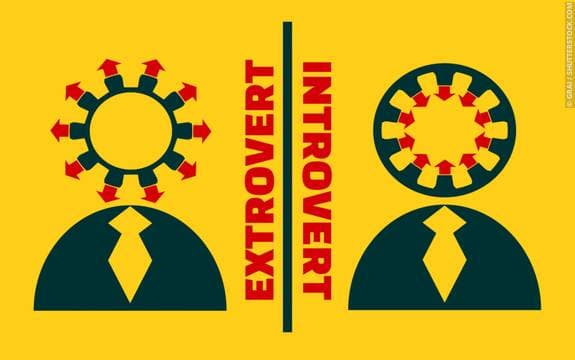
When parents spot the comment "personality tends slightly towards the introverted" beneath their child's report card, it is only natural for alarm bells to ring about whether the child's social development is on track. Here in Hong Kong, we readily associate the "introverted" student with being "passive," "unpopular" or "not good at socialising," and we tend to encourage these "introverted" students to take part in more group activities and make more friends in order to widen their social circle. Put simply, the word "introverted" usually carries a derogatory undertone, while society at large tends to regard "extroversion" as the norm — something worth emulating and the more desirable personality type. The author's aim here is not to dismiss or criticise these widely held views, but rather to explain the phenomenon and origins of "introverted" and "extroverted" personalities from the perspective of neuropsychology (neuropsychology).
The master of psychoanalysis Carl Jung distinguished between the "extrovert" and the "introvert" based on the different ways people draw psychological energy. The former is inclined to gain energy through contact with the external world, whereas the latter draws energy mainly by connecting with the thoughts and feelings of their own internal world. Every person sits somewhere along an extroversion–introversion continuum: some lean closer to the extroverted or the introverted end, and neither end is better or worse than the other. As neuro-imaging technology has advanced, scientists have tried to understand the behavioural differences between introverts and extroverts in terms of the structure and workings of the brain.
First, different external environments give us different levels of stimulation, which in turn prompt the body to release varying amounts of dopamine — a neurotransmitter that brings us energy — and the right amount of dopamine lets a person function at their best. The dopaminergic pathway in an introvert's brain is more sensitive to dopamine, meaning that only a small amount of dopamine is enough to bring plenty of energy and maintain an optimal psychological state. For this reason, introverts generally prefer solitude and enjoy interacting with only a few people. Conversely, because the dopaminergic pathway of extroverts is less sensitive to dopamine, they are inclined to be in busy, crowded places, to take part in more social activities and to expose themselves to more external stimulation (such as revising while listening to music), so as to obtain more dopamine and reach an optimal psychological state. In other words, once introverts are exposed to too much external stimulation (such as being in a crowd or amid loud music), they suffer overstimulation, their performance declines accordingly, and they are no longer at their best. They therefore tend to favour solitary, quiet environments.
As a counsellor, understanding a student's extroversion–introversion dimension is of course important, but it is even more crucial to assess whether the student's personality is affecting their everyday life, learning and social interaction. Both extroverted and introverted personalities have their own strengths, which is why counsellors emphasise helping the individual to know themselves and to uncover each person's inner resources and potential, so that they can meet the tasks and challenges of life's different stages.
References:
Eve-Cahoon, H. (2003). Understanding the introvert preference. Journal of Nursing Education, 42(5), 191-193.
Mcmanus, M. R. (2018, September 10). Introvert and Extrovert Brains Aren’t the Same.
(This article was originally published on "Boximity Media" on 15 October 2018; click here to read the original.)
Comments
No comments yet — share your thoughts.