

In psychology, "learning" refers to the way people change their patterns of behaviour through experience, and different psychologists understand and explain how humans learn in different ways. Among them, the psychologist Pavlov proposed the theory of classical conditioning, and through the following experiment he demonstrated the importance of classical conditioning (in psychology, the word "conditioning" also refers to "learning"):
(Stage one) First, he got hold of a dog. Whenever the dog saw a piece of meat in front of it, it would automatically start to salivate. Here, the meat is the unconditioned stimulus (US), which in turn produces the salivation, that is, the unconditioned response (UR). Because the dog's salivating at the sight of the meat is a natural reaction that requires no learning, both of these things are unconditioned;
(Stage two) A while later, Pavlov once again placed a piece of meat in front of the dog. This time there was a slight difference: as he set down the meat, he simultaneously rang a bell. In this situation, the sound of the bell is a neutral stimulus (NS), because on its own it cannot prompt the dog to perform any particular behaviour. However, when the meat and the sound of the bell appear at the same time, an association forms between the two, and the sound of the bell goes on to become a conditioned stimulus (CS);
(Stage three) After several occasions on which the meat and the sound of the bell appeared together, Pavlov found that the sound of the bell (conditioned stimulus) alone was now enough to make the dog salivate. This salivation by the dog is termed the conditioned response (CR), because this behaviour can only arise after "learning" (stage two).
Finally, Pavlov discovered that other stimuli similar to the sound of the bell (or to the unconditioned stimulus US itself) — such as a telephone ringing — could also make the dog salivate (conditioned response, CR), a phenomenon known as stimulus generalization.
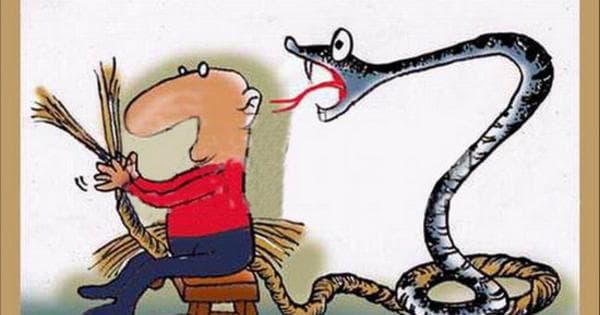
So, when we are bitten by a snake, we feel pain and fear; the former is the unconditioned stimulus (US) and the latter is the unconditioned response (UR). But because the shape of a rope resembles a snake, generalization occurs. As a result, the mere sight of a rope is enough to make us feel a jolt of alarm throughout the body (conditioned response, CR).
Besides "once bitten by a snake, ten years afraid of ropes", what other everyday experiences can be explained using classical conditioning?
(This article was first published on "VJ Media" on 9 October 2018; click here to read the original)
Reference: Pavlov, I. P., & Anrep, G. V. (2003). Conditioned reflexes. Courier Corporation.


Comments
No comments yet — share your thoughts.