Perspective-Taking: Seeing It From Their Side
Perspective-taking is the skill of understanding another person's feelings and behaviour by imagining their point of view. Here's how it differs from empathy, why it matters, and how to practise it a…

Perspective-taking is the skill of understanding another person's feelings and behaviour by imagining their point of view. Here's how it differs from empathy, why it matters, and how to practise it a…
Perspective-taking, known in psychology as perspective-taking, is the cognitive process of understanding another person's feelings and behaviour by imagining their point of view (Galinsky et al., 2008). It is not simply "empathy", because empathy involves more of an emotional resonance, whereas perspective-taking analyses another person's position and motives from a rational angle. Take an example: when a friend keeps checking their phone during a gathering, you might feel they don't respect you; but if you take their perspective and think about how they could be dealing with an urgent work or family matter, your negative feelings ease. This ability is everywhere in daily life, and it can play an important role in everything from family relationships to communication at work.
Research shows that perspective-taking can effectively improve the quality of interpersonal interactions (Todd & Galinsky, 2014). Within a family, when parents can understand the source of a child's stress, they are less likely to be quick to criticise; at work, when a manager can appreciate a team member's workload, they can assign tasks more reasonably. Perspective-taking not only reduces misunderstandings but also fosters collaboration and creativity. For instance, within a team, members who can see a problem from one another's angle find it easier to arrive at innovative solutions (Ku et al., 2015). For this reason, cultivating the capacity for perspective-thinking does not only make us better communicators; it also strengthens our leadership and problem-solving skills.
Perspective-taking makes communication more effective. When we can understand another person's needs and feelings from their angle, it becomes easier to choose the right way to express ourselves. For example, when your partner complains about heavy work pressure, if you take their perspective and recognise that they need support rather than advice, you won't rush to offer solutions but will instead choose to listen and reassure. This way of communicating lets the other person feel understood, building a deeper connection.
Perspective-taking is also key to resolving conflict. In an argument, we often see only our own needs and position, overlooking how the other person feels. If we can take their perspective, we can see the many sides of a problem and so find win-win solutions. For example, at work, when two departments clash over the allocation of resources, if both sides can understand each other's needs from the other's angle, it becomes easier to reach consensus. This ability not only defuses conflict but also fosters team harmony and collaboration.
To develop the skill of perspective-taking, you first need to learn to ask questions and listen actively. When interacting with others, don't rush to express your own view; instead, ask more about how the other person feels and what they think. For example, questions like "What does this mean to you?" or "How would you like me to support you?" can help you understand the other person's position more deeply. At the same time, when you listen, pay attention to the details—including the other person's tone, expression and body language—as these can all offer important clues.
Role-play practice is also an effective method. You can try, in everyday situations, to deliberately think about a problem from another person's angle. For example, when you see a colleague working late on their own, try to imagine the pressures and challenges they might be facing. This kind of practice lets you apply perspective-taking more naturally in real situations. In addition, role-playing games are also a fun way to practise. By acting out another person's role, you can experience their feelings and needs more vividly.
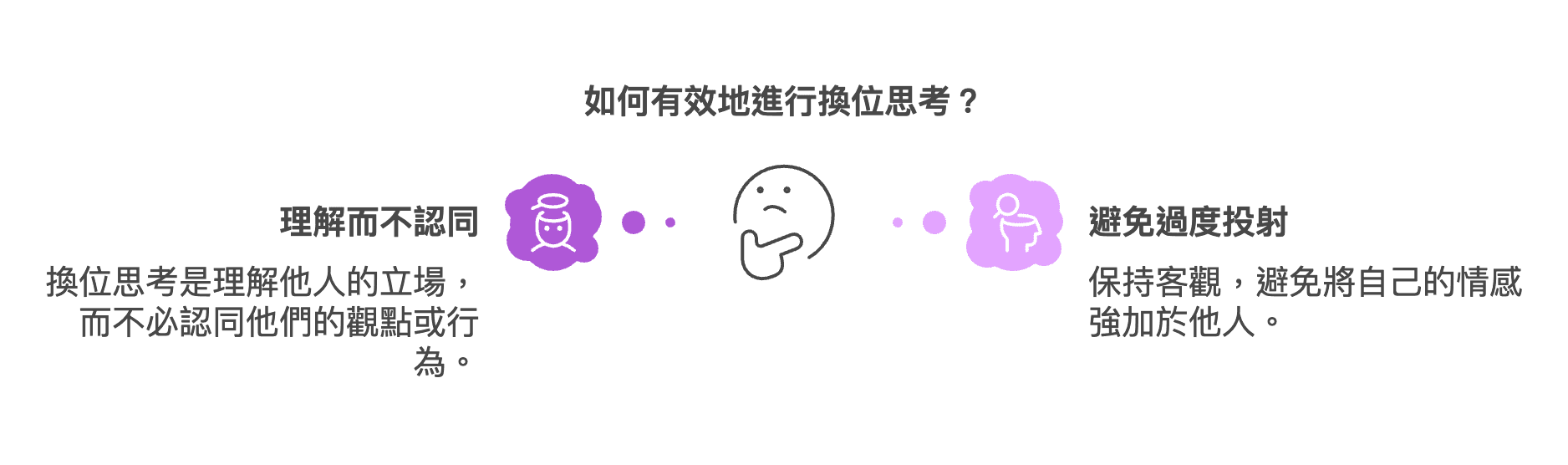
A common misconception is to assume that perspective-taking means agreeing with the other person's behaviour or view. In fact, perspective-taking only means understanding the other person's position; it does not mean you have to agree. For example, when you understand that a colleague is being irritable because of stress, you can choose to be tolerant without endorsing their behaviour. Making this distinction lets you hold on to your own principles while staying empathetic.
Another misconception is over-projection—that is, imposing your own emotions and experiences onto others. For example, when you see a friend hesitating in a relationship, you might over-read their feelings because you have been through something similar yourself. To avoid this, you need to stay objective and try as far as possible to understand their behaviour in light of their own background and personality. This takes a degree of self-reflection and restraint, but it makes your perspective-taking more accurate and effective.
Within a family, perspective-taking can reduce conflict and deepen closeness. For example, when you find that your parents have opinions about your career choice, if you can take their perspective and understand that this comes from care and worry, you can communicate with them more calmly rather than reacting defensively at once. This way of communicating makes family relationships more harmonious.
At work, perspective-taking can strengthen team collaboration and leadership. For example, when you are asked to complete a task within a tight deadline, if you can understand that your manager may also be under pressure, you won't rush to complain but will instead choose to cooperate and offer support. This attitude can earn you more trust and respect at work.
In social settings, perspective-taking can make you a more welcome person. For example, when you notice a friend going quiet at a gathering, if you can take their perspective and understand that they may not be comfortable in lively settings, you can take the initiative to chat with them about something light, so they feel cared for. These considerate interactions make your social relationships more solid.
Want to take your team's perspective-taking skills a step further? Join our "Team Psychology Adventure", which uses games and psychological tools to help your team learn collaboration and communication skills in a relaxed atmosphere. Sign up now and begin a psychological adventure made just for you!
Perspective-taking is a skill that can be trained. TreeholeHK's corporate training uses interactive workshops to let team members practise seeing problems from the other person's angle in a safe environment—and when empathy becomes part of the team culture, communication friction naturally eases.
Galinsky, A. D., Maddux, W. W., Gilin, D., & White, J. B. (2008). Why it pays to get inside the head of your opponent: The differential effects of perspective taking and empathy in negotiations. Psychological Science, 19(4), 378-384. https://doi.org/10.1111/j.1467-9280.2008.02096.x
Todd, A. R., & Galinsky, A. D. (2014). Perspective‐taking as a strategy for improving intergroup relations: Evidence, mechanisms, and qualifications. Social and Personality Psychology Compass, 8(7), 374-387. https://doi.org/10.1111/spc3.12116
Ku, G., Wang, C. S., & Galinsky, A. D. (2015). The promise and perversity of perspective-taking in organizations. Research in Organizational Behavior, 35, 79-102. https://doi.org/10.1016/j.riob.2015.07.003

Do you believe in mind-reading? Do you know how to find your own emotional core? The "Team Psychology Adventure" brings together fun, problem-solving, communication and reflection, using games and a range of psychological tools such as the BIG5 personality test and cognitive biases to strengthen the team's bonds. From understanding what motivates team members at work, to building effective communication and making major decisions, the fingerprints of psychology are everywhere in the countless things we do at work. Let us join you on a psychological adventure made just for your team.

This training programme can provide comprehensive knowledge of management psychology, helping participants build excellent leadership ability—it is especially suited to the management tier of different organisations. Participants will first understand the concept of psychological safety and how to cultivate psychological safety within a team. Next, they will learn and apply situational leadership models and a range of leadership feedback techniques, enabling them to flexibly use different leadership styles and communication modes to manage their teams.

In a fiercely competitive market, traditional sales pitches alone can no longer meet customers' needs. We need to evolve from being mere salespeople into trusted advisers who genuinely understand customers' needs. The "Consultative Selling Workshop" uses psychology to help you understand customers more deeply, build genuine customer relationships and offer useful solutions, leaving customers thoroughly satisfied.

Keep reading
Workplace
Workplace
Personal Growth



Comments
No comments yet — share your thoughts.