

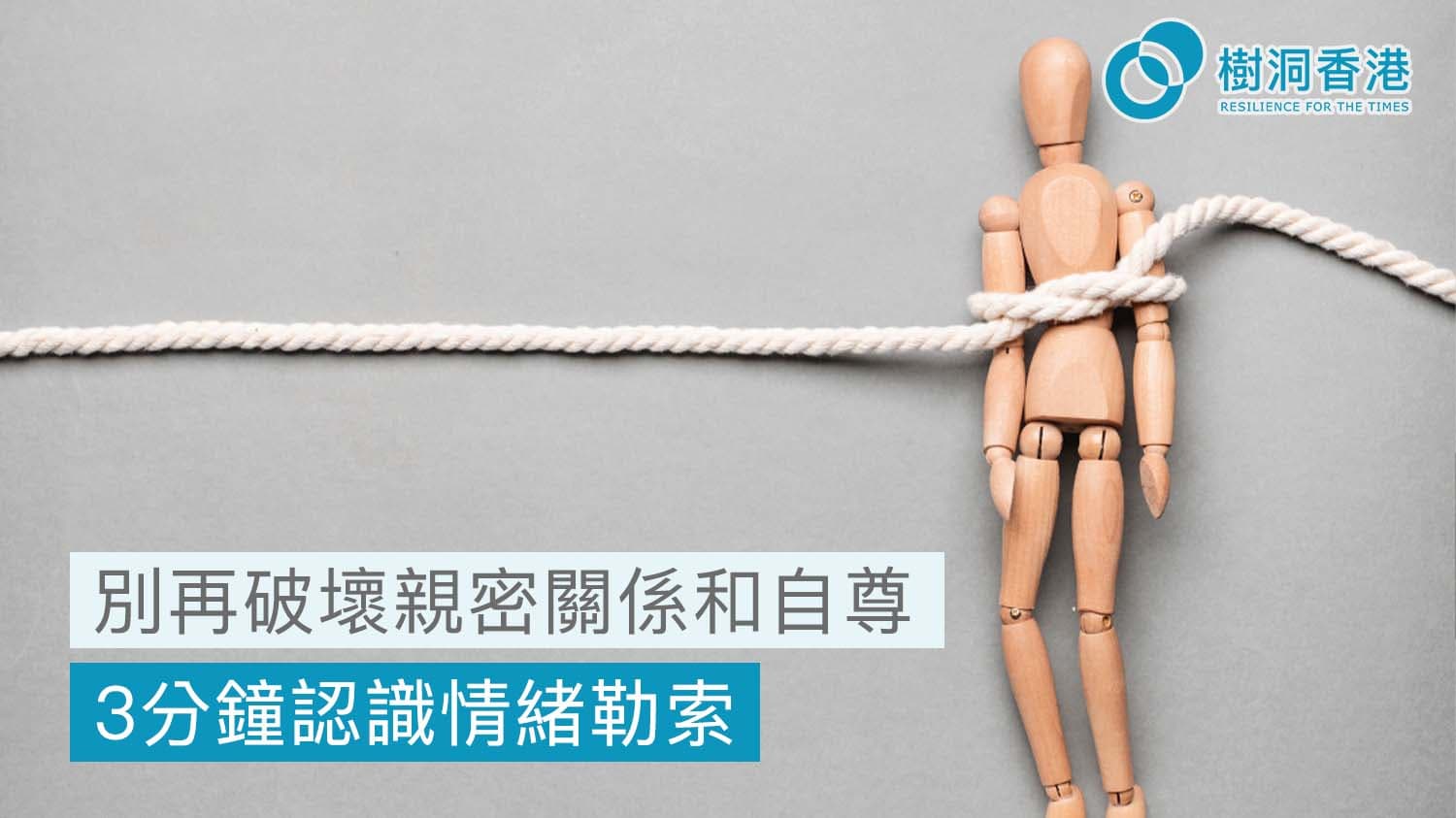
Have you ever heard about emotional blackmail, or even lived through it? More than a few of the writer's own friends are going through exactly this bind.
One of these friends is dealing with emotional blackmail from his mother. This friend (let us call him A) discovered in Primary Six that, although his father seemed to care a great deal about the family, he had begun drinking heavily and carrying on an affair. As a homemaker, his mother was naturally devastated when she found out, and she would often pour out her grievances to A, telling him she only stayed in the marriage because she did not want A to grow up in a broken home — so he had better study hard and repay her. For years, A was an exceptionally dutiful son. It was only after he reached university that he started to become financially independent, found a girlfriend, and began to entertain the idea of emigrating. When his mother found out, she was strongly opposed, and she started saying things to A like: "If you leave, there'll be no one to look after me when the time comes, and I'll be stuck living with that worn-out old man. Your mother really doesn't count for anything." "After all the bitter struggle I went through to raise you, you go and side with some girlfriend who isn't even blood — do you think my life isn't hard enough already?"
As much as A wanted to emigrate, hearing these words day after day only deepened his guilt. He had once told his mother how much he longed for life abroad, but her reaction was even more extreme than usual. So A no longer dared raise the subject of emigrating in front of her, and his and his girlfriend's plans to move were pushed to one side.

A self-check – Are you caught in the trap of emotional blackmail?
Emotional blackmail became a widely known idea after it appeared in the book Emotional Blackmail: When the People in Your Life Use Fear, Obligation, and Guilt to Manipulate You by psychotherapist Susan Forward. She defines it as a kind of emotional domination that is persistent and powerful: the blackmailer arouses the victim's fear, obligation and guilt, threatening that if the victim fails to meet the blackmailer's goals they will be punished or abandoned (Forward & Frazier, 1997). Forward also proposed that emotional blackmail involves a six-step cycle:
Step one: Demand
Step two: Resistance
Step three: Pressure
Step four: Threats
Step five: Compliance
Step six: Repetition
Let us read it through the example of A above:
The demand his mother makes is that he not emigrate. A resists, telling his mother how much he would love to live abroad. His mother's reaction grows even stronger, and she piles pressure onto A. After that, she threatens A indirectly — that is, she hints obliquely at how hard her own life is. In the end, A cannot stand up to his mother's "sympathy card" and chooses to comply and give up emigrating. Because compliance reinforces the blackmailer's threats, the mental health of many victims deteriorates after experiencing emotional blackmail, and the relationship between the two parties becomes damaged as well (Forward & Frazier, 1997).
The blackmailer's "cards"
After reading the example above, you — having also lived through emotional blackmail — may ask: "The blackmailer I'm dealing with doesn't play the 'sympathy card'; so does he or she still count as emotionally blackmailing me?" In fact, different blackmailers each have their own routes and forms for carrying out emotional blackmail. Forward broadly divides blackmailers into four types:
- The Punisher
- The Self-punisher
- The Sufferers
- The Tantalizers

The Punisher type of blackmailer has perhaps the most obvious threatening form. They will tell you clearly: if you fail to meet my demand, you will face consequences. The consequence can be anything — for example, cutting off your money or supply of resources, or severing emotional contact. Punishers can be further divided into two types: those who express themselves actively and those who express themselves passively. An active Punisher may threaten you clearly in words, for example: "If you don't help me finish this, I'll report you to the manager!" A passive Punisher may give you the cold shoulder, treating you as if you do not exist. This type of blackmail is the most likely to arouse the victim's fear, and so the victim chooses to comply with the demand.
The Self-punisher type of blackmailer turns the threat onto themselves, threatening the victim that if things do not go according to their own plan, they will bear the consequences; for example, their depression will flare up again, or they may even hurt themselves. Those who become Self-punisher blackmailers are usually more needy, and tend to be poorer at taking responsibility for their own lives. What is more, this kind of blackmail stirs up the victim's sense of responsibility and guilt, leading the victim to believe they must take on the duty of caring for the blackmailer's well-being.
The Sufferer type of blackmailer is also the kind that blames the victim and makes them feel guilty. Sufferers express, through various postures or behaviours, how much pain, hardship and heartache they are in, how unfortunate they are, and so on. They stir up the victim's guilt and expect the victim to grasp their needs; if those needs are met, they will be better off. If the victim cannot see through or read the blackmailer's demands, they will be seen as not caring enough about the blackmailer.
The Tantalizers encourage the victim to fulfil their aims, because once it is done there may be a good reward to be had. But in reality, the Tantalizer type of blackmailer does not keep their promises; instead, they will demand that the victim accomplish even more goals before any reward is given. Slowly, the victim ends up doing more and more for the blackmailer.

Did emotional blackmail simply appear out of nowhere?
We just mentioned that emotional blackmail only became widely known after 1997 — so does that mean people before 1997 experienced no emotional blackmail at all? Not at all. So when Karnani and Zelman (2019) studied emotional blackmail between partners, they analysed how emotional blackmail resembles and differs from other related concepts of interaction patterns and personality traits.
First, the similarity between emotional blackmail and the concept of emotional manipulation is that both describe a repetitive and transactional habit used to achieve interpersonal goals. Emotional manipulation is not inherently bad, because it is simply human beings wanting to secure the material things and relationships needed for survival; it is not in itself good or evil. By contrast, Forward and Frazier (1997) point out that emotional blackmail is itself negative, because fear, obligation and guilt weaken the victim's self-esteem and autonomy.
Second, there is emotional blackmail and enmeshment. Enmeshment refers to a close relationship that has the following features: blurred interpersonal and emotional boundaries, and blurred individualities. Hann-Morrison (2012) hypothesised that enmeshment is rooted in manipulation and control, together with a degree of intimacy that restricts emotion. Loyalty to the family is confirmed through demands for displays of love and solidarity. Both emotional blackmail and enmeshment weaken the victim's independent thinking and behaviour, but emotional blackmail describes a certain two-way mode of communication, whereas enmeshment describes a relationship feature rather than a mode of communication.
Third, Machiavellianism is a pattern of consciously manipulating and exploiting others for personal gain. It is related to emotional manipulation and psychopathy, but is inversely related to enmeshment. This trait is also regarded as one of the broader personality tendencies, which can include manipulative communication — that is, emotional blackmail.
Fourth, "The Four Horsemen of the Apocalypse" are four dysfunctional communication patterns proposed by the American psychologist John Gottman that can predict divorce and abuse between partners. They include: criticism, contempt, defensiveness and stonewalling (Gottman et al., 1995). Karnani and Zelman (2019) point out that both emotional blackmail and "The Four Horsemen" can describe repetitive and negative communication between partners, but emotional blackmail uniquely can be used to describe manipulation in interpersonal relationships (not only between partners).
Finally, there is emotional abuse and Intimate Partner Violence (IPV). Emotional abuse includes coercion, harassment, the silent treatment, threats, and punishing moods used for control and domination (Karnani & Zelman, 2019). Some scholars say emotional blackmail is a "variant" of emotional abuse (Lammers et al., 2005); some scholars consider the concepts of emotional blackmail and intimate partner violence to be of "moderate" closeness (O'Campo et al., 2015); and some consider the two to be of "high" closeness (Karnani & Zelman, 2019).
From this we can see that emotional blackmail is closely bound up with other psychological concepts.
Is it love? Is it responsibility? Or is it……
Now we know how emotional blackmailers use our fear, obligation and guilt to get their demands met. We also know that, across many relationships and situations, we will come across many incidents that resemble emotional blackmail. But we also need to tell clearly when another person's demand is reasonable. For instance, if you spent the past month neglecting your meals to play video games, and your mother then asked you to switch off the computer and threatened to give it away to someone else, her motive would be to get your life back on track — and besides, in the past you really did ignore her appeals. So this would be a reasonable demand.
Besides, does this mean the blackmailer deserves all the blame? As the saying goes: "One hand cannot clap; one person cannot sing a solo to a duet." If we, too, know how to protect ourselves — distinguishing clearly what counts as love, what counts as a responsibility we ought to bear, and what counts as an excessive demand — and set boundaries for ourselves, resolving not to let others tear them down, then we can keep emotional blackmail from entering our lives.
References:
Forward, S., & Frazier, D. (1997). Emotional blackmail. Bantam.
Gottman, J., Gottman, J. M., & Silver, N. (1995). Why marriages succeed or fail: And how you can make yours last. Simon and Schuster.
Karnani, S. R., & Zelman, D. C. (2019). Measurement of emotional blackmail in couple relationships in Hong Kong. Couple and Family Psychology: Research and Practice, 8(3), 165–180. https://doi.org/10.1037/cfp0000126
Hann-Morrison, D. (2012). Maternal Enmeshment. SAGE Open, 2(4), 215824401247011. https://doi.org/10.1177/2158244012470115
Lammers, M., Ritchie, J., & Robertson, N. (2005). Women's Experience of Emotional Abuse in Intimate Relationships. Journal of Emotional Abuse, 5(1), 29–64. https://doi.org/10.1300/j135v05n01_02
O'Campo, P., Smylie, J., Minh, A., Omand, M., & Cyriac, A. (2015). Conceptualizing acts and be- haviours that comprise intimate partner violence: A concept map. Health Expectations, 18, 1968– 1981. http://dx.doi.org/10.1111/hex.12291



Comments
No comments yet — share your thoughts.