Does Your Brain Decide Before You Do?
There is an old riddle: what is the one thing everyone loves? The answer is freedom. But is human freedom really as inviolable as we like to believe, or does the brain decide before we do?


There is an old riddle: what is the one thing everyone loves? The answer is freedom. But is human freedom really as inviolable as we like to believe, or does the brain decide before we do?
I still remember a clever riddle I heard as a child: what is the one thing everyone loves? The answer was "freedom". And it rings true — bear's paw for one, frost on the road for another; even the rarest delicacy is not to everyone's taste. Only freedom is loved by all.
A person's freedom of action can be stripped away with ease — the Chinese Communist Party, for one, are experts at it. Freedom of thought, however, seems sacred and inviolable. Liu Xiaobo once said: "Even if I were ground into powder, I would embrace you with my ashes." No matter how cruel the punishment the Party heaped on him, it could not extinguish his will.
But is that really the case? Last century, an experiment by the psychologist Benjamin Libet caused an uproar in academic circles. It ran like this: Libet told a group of participants that they could press a red button in front of them whenever they liked, on a whim. Each participant had an electroencephalogram (EEG) attached to their head. There was also a small clock on the table, and Libet asked the participants to note the moment they first felt the urge to press the button. The result was startling: roughly 0.3 seconds before participants reported feeling the urge, the EEG recorded a particular surge of electrical activity in the brain (the Readiness Potential). This implied that, before we consciously make a decision, the brain undergoes some kind of physiological reaction that we are unaware of.
The experiment quickly gave rise to a hypothesis: every decision we make is the product of a physiological reaction, and that reaction is beyond our control. Put plainly, human beings have no free will. Of course, the matter was far from settled, for free will is one of the most crucial premises of human civilisation as we know it. Consider this: if every murderer killed without free will, where would the guilt lie? It follows that, were free will overturned, society's notions of responsibility, reward and punishment, and justice would topple one by one like dominoes. It would be nothing short of an earthquake at the very foundations of morality.
Over the following decades, many philosophers and psychologists set out to prove that free will exists. In 2016, Schultze-Kraft and colleagues published a striking study. In their experiment, participants watched a red-and-green light. While the light was green, they could press a button at will; while it was red, they were not to press. As before, they were wired up to an EEG — but this time the EEG analysed their brain activity and tried to turn the light red at the moment they were about to press. In short, it was a duel between computer and human brain. The participants were to press the button as often as they could while the light was green, while the computer was to control the timing of the red light to stop them whenever possible. The result was clear: even after the Readiness Potential had appeared, participants could still control whether to halt the action. That said, if a participant did not stop themselves in time, around 0.2 seconds before pressing, there was almost no turning back. And although participants were told the computer would predict their movements and were advised to act as unpredictably as possible, this did not in practice make their actions any harder to predict. But at the very least, the experiment showed that an urge welling up — together with the physiological activity preceding it — cannot fully govern a person's behaviour: a person can act according to their will and choose not to respond to the urge.
What this study found chimes closely with the way mindfulness (Mindfulness) understands the human mind. In mindfulness meditation, a person cannot control when a thought wells up in the mind, yet can control whether to respond to it. In meditation, for instance, you are meant to focus on the breath, yet you may grow very weary. At that point the meditator can freely give simple attention to the feeling of weariness, then gradually return attention to the breath, rather than ending the practice the moment weariness sets in. True, there are times when we are still gripped by the feeling of weariness and forget entirely the aim of focusing on the breath; but freedom, understood this way, is not an all-or-nothing thing — it is an ability that can be trained. As a person meditates more, they naturally come to observe the things that lead the mind to wander, without being pulled along by them. As Hyland (2014) puts it, even if what mindfulness meditation achieves is not total freedom, a state of mind free of fetters is the condition closest to free will.
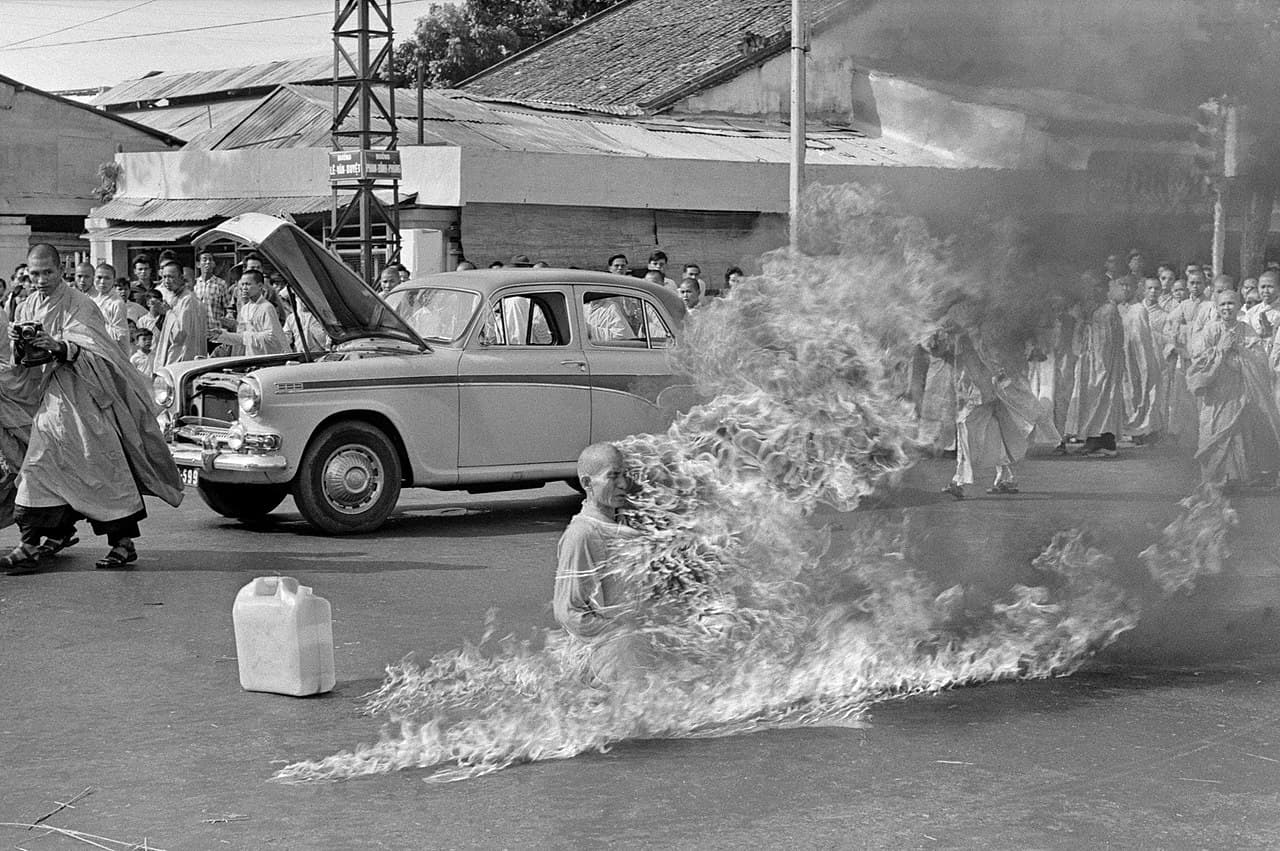
Speaking of meditation and freedom, one cannot but mention the Vietnamese monk Thích Quảng Đức. At the time, the South Vietnamese government was persecuting Buddhists in the name of Catholicism, and Thích Quảng Đức set himself alight before a great crowd in protest. Throughout the whole ordeal he uttered not a word, his face composed, showing no sign of suffering — a striking contrast to the people weeping around him. A monk is human, and of course felt the agony in his flesh, yet he held fast, unmoved. The height of freedom is surely nothing other than this.
Of course, becoming such a monk is not what everyone wishes for. But understanding freedom through the lens of mindfulness is precious because freedom yields more the more you work at it. You need not train yourself to the point where you can endure torture with calm. If, the next time your mother comes home soaked from the rain, you can observe a flash of irritation and yet remain unmoved by it — and instead feel grateful for the kindness that raised you — that alone is a great achievement.
References:
Hyland, T. (2014). Mindfulness, Free Will and Buddhist Practice: Can Meditation Enhance Human Agency?. Buddhist Studies Review, 31(1), 125-140.
Schultze-Kraft, M., Birman, D., Rusconi, M., Allefeld, C., Görgen, K., Dähne, S., … & Haynes, J. D. (2016). The point of no return in vetoing self-initiated movements. Proceedings of the National Academy of Sciences, 113(4), 1080-1085.
Libet, B., Gleason, C. A., Wright, E. W., & Pearl, D. K. (1983). Time of conscious intention to act in relation to onset of cerebral activity (readiness-potential) the unconscious initiation of a freely voluntary act. Brain, 106(3), 623-642.



Comments
No comments yet — share your thoughts.