

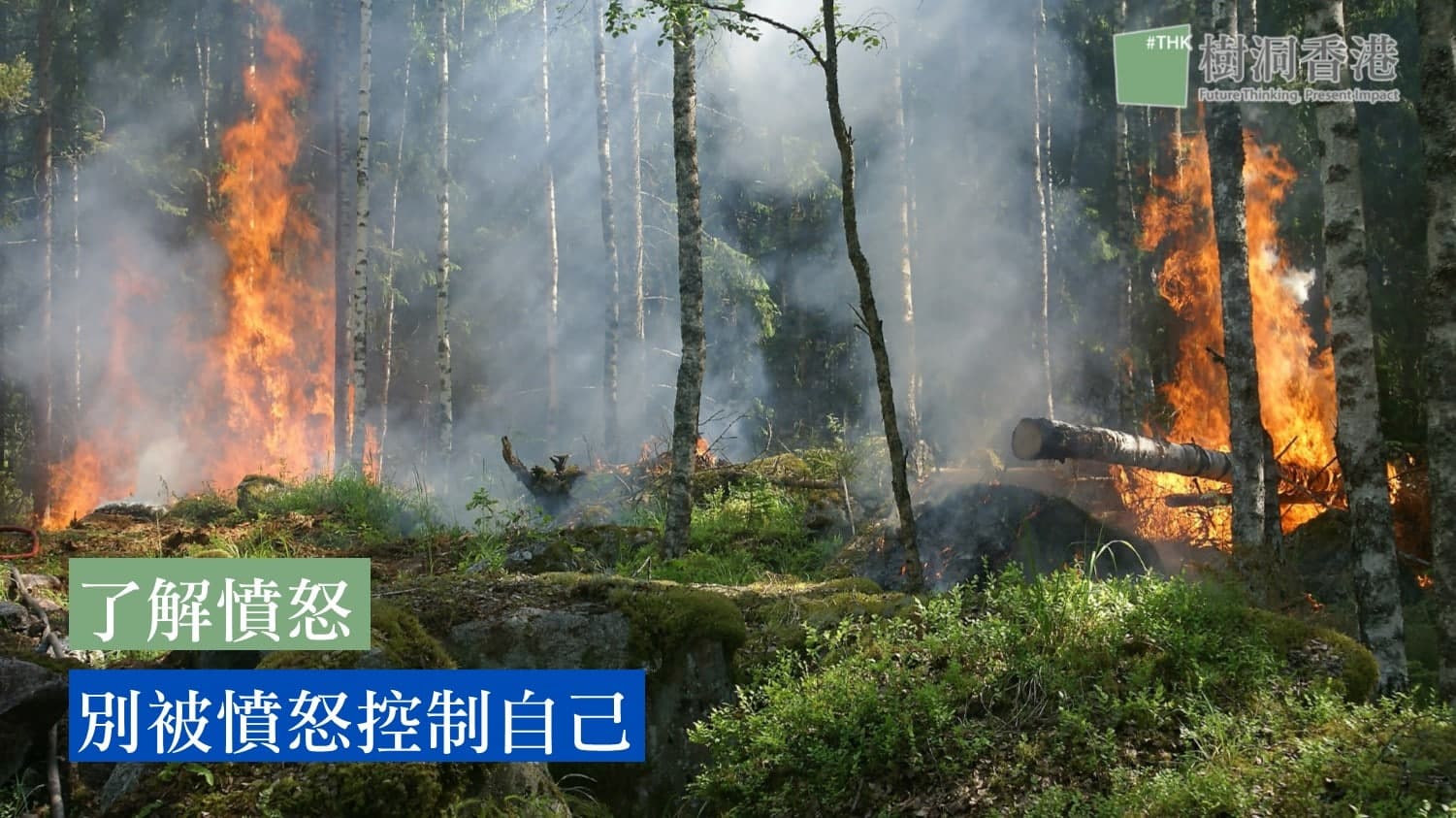
Anger is one of the basic human emotions (Basic Emotion). It can be triggered when something we value is violated, or when others try to harm us. In everyday life, we tend to treat anger as a purely negative emotion that does nothing but damage. Over the past year, we have at times heard it said that Hong Kong people ought to stay angry. Anger is a normal human response, and in itself it is neither good nor bad. It is the wrong expression of feeling that causes the real trouble. Before we look at how to keep our own anger in check, let us first take another look at what kind of emotion anger really is.
What anger is for
Under the influence of the evolutionary psychology first proposed by Darwin, psychologists generally believe that emotions serve a function. The reason modern humans have emotional responses at all is that emotions allowed our ancestors to make adaptive (Adaptive) responses to their surroundings, increasing their chances of survival and passing these responses down into our genes. The easiest example to grasp is fear. Fear drives the fight-or-flight response when we encounter danger, getting us away from a threat as quickly as possible.
So what use is anger to us? We can think back to the last time we were angry. Perhaps it was because someone cheated us out of money, perhaps because someone mocked us, or perhaps because of an act of tyranny. Whether the cause of our anger rests on personal interest or on the ideals of a group we belong to, the moment we feel angry is usually accompanied by an urge to act — to take back the money that is ours, to retaliate, to stand against injustice. The first function of anger is to spur us to defend what is ours, which might be resources we value, our self-esteem, or our ideals. Anger lets a person take the initiative to protect their own interests, or society's, when they are violated; and if anger can be channelled into solving a problem or fighting for justice, we can reclaim what is ours, preserve our dignity, and hold fast to the values our community holds dear. Without anger, we might simply give up the things that have been taken from us. Anger allows a person to push back quickly and protect the people and things they consider important.
Clinical psychologist Leon Seltzer, who has studied anger closely, has offered further insight into the relationship between anger and the self. Anger has a self-soothing (Self-Soothing) effect. As an agitating emotion, anger may seem to have nothing to do with comfort, yet Seltzer argues that it can soothe a person's inner unease and vulnerability. When we are scolded, criticised or insulted, our self-image is threatened by others, and it is only natural to feel angry, to want to fight back, to refuse to accept these attacks on the self. Seltzer believes the emotion of anger has, in itself, already eased the unease of being criticised, because under anger a person can lay the blame on others — when they cannot settle themselves, they choose rage in place of unease, numbing the feelings of hurt and fragility and keeping their self-image intact. Seltzer further points out that anger can make a person feel full of power (Self-Empowerment). In moments of anger we feel capable of anything, full of drive. Seltzer argues that anger gives a person a false sense of power; although this strengthens their self-image and makes them more confident about solving problems and protecting themselves, it can also lead them to rely on anger, neglect other, more constructive solutions, and even develop a problem of being addicted to anger. Drawing Seltzer's view together, anger does not only push a person to act and defend their interests — it can also protect the self, shielding it from outside harm, so that even when facing difficulty a person can keep an intact self-image and confront the violation in a more confident state.
Don't be controlled by anger
Although the passage above describes how anger can motivate us, readers will surely be no strangers to its destructive power. Modern society is not the same as primitive society; if we strike back every time we feel angry, we not only fail to solve the problem but invite far greater trouble. Letting anger loose at will can easily escalate a misunderstanding into a quarrel or an argument, harming our relationships with others. In some situations, anger masks the other emotions within us — perhaps sadness, self-pity or jealousy. These hidden emotions represent certain thoughts or longings of ours, and if too much anger keeps us from feeling them, they may end up expressed in maladaptive (Maladaptive) ways. Left unaddressed, both the way anger itself is expressed and the way it interacts with other emotions can affect our daily lives. To avoid being controlled by anger, we must learn the methods of emotional management.
Now that we understand the meaning behind anger, the next time rage wells up again we can understand our own state from another angle, rather than simply being controlled by it. Of course, knowing that anger signals a violated interest, a call to fight back, a call to protect ourselves, is not the end of the story. In the moment of intense anger we are usually unable to respond rationally, and so my advice is not to rush into solving the problem, but rather to relax through deep breathing and quiet-sitting practice, easing our anger a little. But this does not mean we are merely avoiding the problem or suppressing the anger; once we have calmed down, we should face the problem rationally, understand properly the need that lies behind the anger, and address the source of the anger at its root.
Beyond adjusting our response when anger flares up, we can also work on cultivating our character, preparing ourselves to face negative emotions that arrive unexpectedly. Practising mindfulness can keep us, when an emotion arises, from falling back into the automatic reactions of negative emotion; it lets us detach amid the impulse and quietly observe the emotion as it arrives, and how our own thoughts and behavioural impulses shift along with it. Practising mindfulness makes us aware that observing an emotion and being swept up in it are two different things, allowing us to respond of our own accord when facing negative emotions. Of course, practising mindfulness takes practice. Readers who have not encountered mindfulness before can start by trying TreeholeHK's guided mindfulness audio to explore their own emotions. Those interested in getting to know mindfulness further may consider enrolling in a full mindfulness course, letting mindfulness bring change to their life.
Anger is an emotion everyone experiences. Every emotion has its own purpose, and rather than suppressing or avoiding negative emotions, we ought all the more to understand the message behind an emotion, to try not to be controlled by it, and not to let ourselves become slaves to our emotions.



Comments
No comments yet — share your thoughts.