
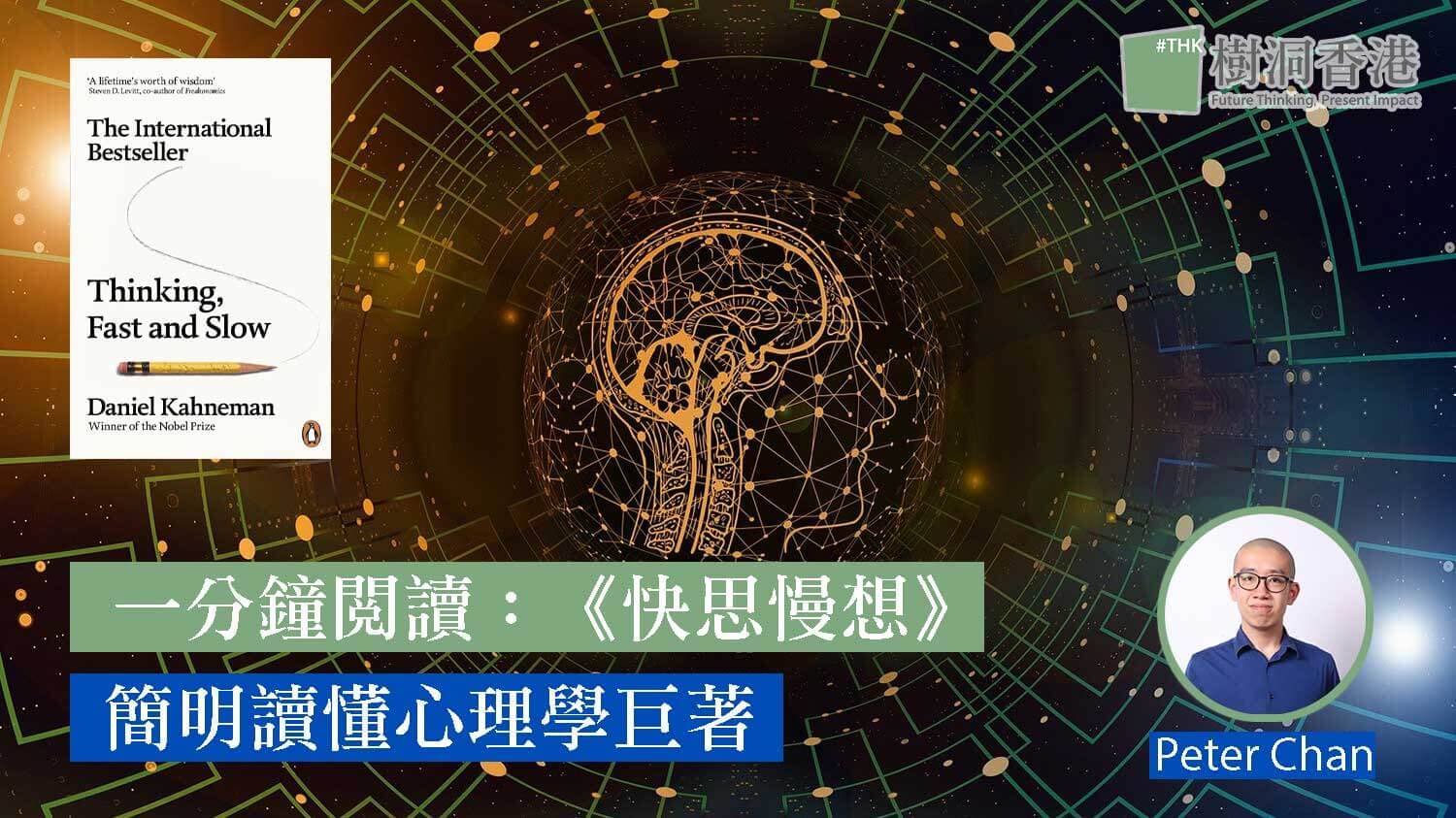
As the saying goes, "A woman's intuition is rarely wrong." Gender aside, just how trustworthy or accurate is human intuition? Nobel laureate in economics and behavioural-psychology giant Daniel Kahneman argues that leaning too heavily on intuition can easily lead us into traps of thought.
System 1, fast thinking; System 2, slow thinking
Thinking, Fast and Slow distils decades of Kahneman's research into economics and behavioural psychology. Drawing on his understanding of human thought and combining it with earlier psychological studies, Kahneman proposes that our thinking can be divided into two systems. System 1 is instinctive, reflexive thinking: it runs quickly, uses little energy, and operates unconsciously. When we speak Cantonese, for instance, we don't have to work out how to pronounce each word or what tone to use.
System 2, by contrast, is careful thinking. It runs more slowly and demands concentrated effort to control — when you read out an unfamiliar, awkward foreign word, for example, you have to think hard about how it is pronounced. Because System 2 drains our mental energy, the brain generally prefers to rely on System 1 and use System 2 sparingly.
Although System 1 thinks quickly and uses little energy, there are times when it simply can't handle the task. What's more, System 1's thinking is rough and ready — it looks only at the surface and overlooks the details, so it easily leads us into the traps of cognitive bias. Here's a problem to picture, for example: suppose a type of bacteria doubles once a minute, and by minute 60 there are one million cells. So at what minute would there be half a million cells? Many people's intuition tells them 30 — that's the answer System 1 hands over. But think it through again, and the real answer is minute 59.
The author therefore says that if we want to avoid errors, we have to recognise that human thinking can't be trusted as completely as we imagine. Sometimes we make decisions we believe are rational, when in fact they are nothing more than System 1's intuitive reactions — and it is far from easy to tell whether a given decision came from System 1 or System 2. What we can do is to bring a little more doubt and reflection to our first reaction to anything — not by distrusting intuition, but by understanding what influences our thought process, so that we can make decisions that have been thought through with care.
Overcoming System 2's laziness
System 2 is lazy, which is why we so often fall into the trap of System 1's intuitive thinking. So how can we get System 2 working harder, and make our thinking and decisions more accurate? Daniel Kahneman points out that activating System 2 usually takes some kind of prompt. It can be a self-prompt, such as asking yourself, "Do I really need to buy this?"; or it can be an external prompt, such as a sign reading "Wet weather, slippery road — drive carefully."
The author also notes, however, that not every situation in life comes with such prompts, and cognitive biases are not always so easy to spot. As the saying goes, "Those in the thick of it are blind; the onlooker sees clearly." This is why other people's opinions matter so much: our intuition may cause us to gloss over certain key points, but those around us don't share our intuition and can only think with System 2 — which is precisely why they often spot what we have missed.
Download MindForest AI and build your resilience in the face of psychological challenges
MindForest is a psychology-based AI app that offers a range of tools and strategies to help you improve your mental well-being, and to think more clearly and plan more effectively when you face complex psychological challenges.

- Use psychological techniques to strengthen your mental resilience: Kahneman's two thinking systems — System 1 (fast thinking) and System 2 (slow thinking) — help us understand the difference between an intuitive reaction and careful thought. The interactive courses offered by MindForest combine psychological insights to help you manage stress and build mental resilience, so that you can think more clearly and avoid falling into traps of thought.
- An AI guide for personalised support: MindForest can offer you emotional support and tailored suggestions for all kinds of emotional concerns. This guide can help you activate System 2 thinking, offering deeper self-insight and helping you handle distress with mature emotional wisdom, so that you can restore your emotional balance.
- A reflective insight journal to encourage self-discovery: When facing psychological challenges, recording your emotional journey is hugely important. MindForest's insight journal lets you record your feelings and reactions, deepening your self-awareness and helping you identify emotional triggers to encourage personal growth. This will help you handle your psychological state more effectively and make more precise plans.
- Overcoming System 2's laziness: System 2 thinking demands concentration and conscious effort, and so we often neglect it. Discussing the challenges you face with MindForest can help you activate System 2 more often and make decisions that have been thought through with care. This not only improves the accuracy of your decisions, but also helps you stay calm and clear-headed in all kinds of situations.
By using MindForest, you will master the skills you need to manage emotional stress effectively and cultivate the resilience required to overcome psychological challenges. This not only helps you cope with present emotional concerns, but also supports your long-term emotional well-being and personal development. Exchanges with the AI will reveal more insights from deep within, offering valuable support on your journey of self-discovery.
Putting the quirks of human thought to use
System 1 places great weight on feelings, and feelings can sometimes lead us to bad decisions. This is why group decisions are generally less error-prone than individual ones: discussion within a group can offset some personal emotion and ground the discussion in facts. Of course, teamwork has its drawbacks too, and these are something people need to watch out for.
The atmosphere of a formal meeting is often heavy, and differences in seniority can keep many people who have spotted a problem from speaking up — yet decision-makers can't always be relied upon to critique their own decisions. Kahneman therefore suggests it can be worth changing the atmosphere, for example by chatting casually with team members over tea before making a decision. The aim of this approach is to use a more relaxed setting to express and hear every view, while sparing the decision-maker from having to criticise themselves — making full use of everyone's System 2 thinking to help arrive at a more accurate decision.
In its closing pages, the book raises the discussion to a higher plane, showing that these two systems shape not only our decisions but also our outlook on life. Kahneman believes that thinking comprehensively can keep us from dwelling on individual mistakes, and so lift our overall sense of well-being.
"One-Minute Read" recommended book
Thinking, Fast and Slow
Author: Kahneman, Daniel
Published by Commonwealth Publishing Co., Ltd.
This article is adapted from the RTHK: One-Minute Read programme. The article and title have been edited for online reading or otherwise revised. This article may not be reproduced without the authorisation of RTHK.



Comments
No comments yet — share your thoughts.