Books like “FBI Body Language” and “How to Read Anyone in Three Seconds” reliably claim a spot on the bestseller charts. They tend to wrap themselves in the language of science, and the bookshops even file them under “psychology”. No wonder so many of us start to wonder: do these theories actually count as science? And where exactly does the line between pseudoscience and science fall?
P.S. For some genuinely good psychology reading, this article is the one to read.
Pseudoscience ≠ Inaccurate
In this writer’s view, the vast majority of these theories are pseudoscience. I’ll lay out the reasoning behind that claim a little later. But on reading this, your reaction might well be: “Surely not. Last time I went on a date and followed exactly what the book said, and it worked brilliantly! Something this useful can’t possibly be pseudoscience, can it?”
First, it helps to understand that science is not the only way to make sense of the world. In everyday life, I’d venture that most of what we know about relationships is learned in non-scientific ways. For instance, you know that snapping at your girlfriend will make her angry, and you don’t need to run a detailed scientific study to be sure of that. The basis for that conclusion might be your own past experience, common social sense, or simply other people telling you not to do it.
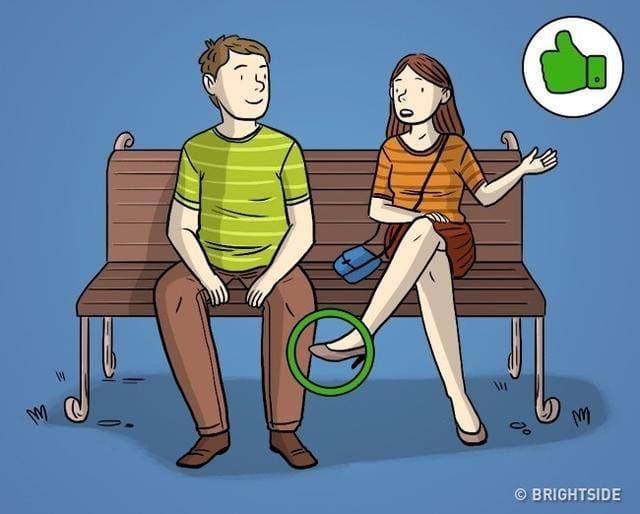
So if someone is well read and has met a great many people, their insight into relationships can be genuinely worth heeding! If they reckon that “where your feet point shows who you fancy”, then it may well be true. But that is the wisdom of experience, not science.
What is pseudoscience?
So what does count as pseudoscience? In short, taking a conclusion reached by non-scientific means and declaring it to be science is pseudoscience. For example, if a person claims that “where your feet point shows who you fancy” is not merely their personal wisdom, but a conclusion drawn from scientific research (when in fact no such research exists), then that is pseudoscience! On the “where your feet point shows who you fancy” claim specifically, this writer once searched Google Scholar for any related research and came up with nothing at all (1). Yet articles online that dress the claim up as science (2)(3)(4) are everywhere you look.
Of course, as noted above, pseudoscience does not equal inaccuracy. Even if a person, deliberately or unwittingly, packages an unverified claim under the banner of “science”, that does not necessarily mean the claim is wrong; after all, it may be a conclusion drawn from the sum of lived experience.
So what, exactly, is the problem with pseudoscience?
Science is pivotal in modern society. The high-rises, the internet and the mobile phones all around us are every one of them a product of scientific research. Why is it that science lets us raise towering buildings and weave together the dense complexity of the internet, while folk wisdom alone cannot? One factor is that scientific knowledge is highly reliable, forming a stable bedrock for the body of knowledge that allows it to keep building upward. To construct the internet, say, you need to grasp physics, electrical engineering, architecture… a whole series of foundational fields, and your understanding of those disciplines has to be correct before you can plan an internet on top of it.
Why is scientific research reliable? That, again, is another deeply complex question. It involves many factors — randomised controlled trials, peer review and so on — which this article won’t go into here. But I trust that “science is broadly reliable” is a conclusion everyone can accept. The word “science” is to knowledge what the “Q-Mark” is to a product: if the scientific community broadly accepts a claim, then we have ample reason to believe it is correct, unless there is a stronger reason not to — such as your finding a flaw in the relevant research.
And the problem with pseudoscience lies precisely here — claims like the “feet” one have not been through scientific research, yet someone has dressed them up as science, leaving the reliability of such claims wildly overstated. To borrow the “Q-Mark” analogy, it is as though a shop that never earned the “Q-Mark” certification went ahead and slapped the “Q-Mark” label on its shopfront to draw customers in — which does not necessarily mean the shop is selling fakes, but deliberately misusing the “Q-Mark” to win consumers’ trust is in itself a dishonest thing to do.
From non-science to science
“Where your feet point shows who you fancy” is a hypothesis: conduct the relevant research, and you can test whether it is true or false from a scientific standpoint. And the value of running such scientific research goes far beyond that: for example, does this hypothesis hold only for a particular culture, gender, or set of other factors? Through rigorous scientific testing, even where no clear answer can be found, we at least deepen our understanding of the question. The relationship between liking or not liking someone and the direction of their feet may not be as simple as a “yes” or “no”. And relationships, intricate and tangled as they are, are not something that books like “How to Read Anyone in Three Seconds” can fully account for.
(1)
https://scholar.google.com.hk/scholar?hl=zh-TW…
(2)
http://www.coco01.today/post/635832
(3)
http://q.getjoys.com/article/3/lDPPRBCq.html
(4)
https://kknews.cc/zh-hk/psychology/gz3goam.html





Comments
No comments yet — share your thoughts.