What Google and Microsoft Know About Great Teams
Work fills at least half the waking hours of most city dwellers, and how well a team gets along has a profound effect on mental health. Drawing on research from Google and Microsoft, we distil the th…

Work fills at least half the waking hours of most city dwellers, and how well a team gets along has a profound effect on mental health. Drawing on research from Google and Microsoft, we distil the th…
Work fills at least half the waking hours of most city dwellers, and whether colleagues get along well has a profound effect on each person's mental health. For managers and HR staff, lifting team performance is more important still. So what exactly determines how effectively a team works?
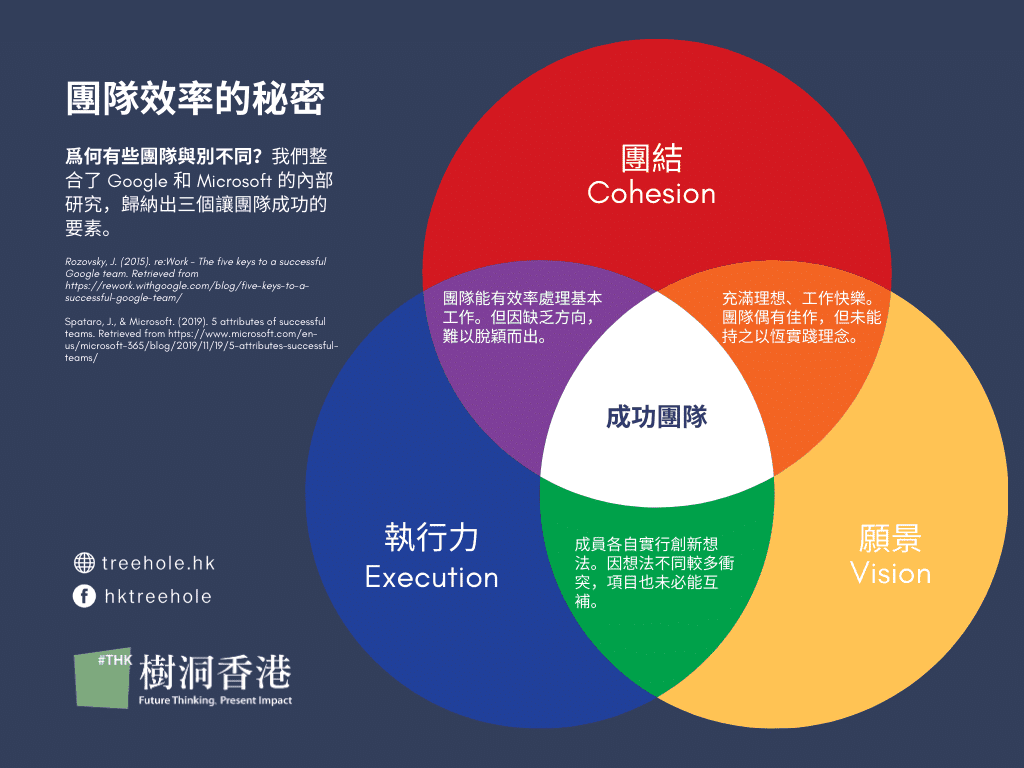
TreeholeHK has pulled together the research from Google and Microsoft to distil the three factors that most shape a team's effectiveness: cohesion, execution and vision.

Google's research found that psychological safety is one of the keys to teamwork – psychological safety means colleagues are willing to take risks without feeling embarrassed when they fail. On a team with high psychological safety, colleagues are willing to take on risk and responsibility, because they know that even if they fail, they will still have the team's support.
The opposite holds too: on some teams, a colleague who slips up is simply blamed. The boss or manager never asks whether the team gave that colleague enough support, and tends to reproach mistakes rather than help the colleague improve. Over time an overly cautious culture takes hold; colleagues shirk responsibility and avoid risk, and the team naturally stalls.
A cohesive team does not, of course, mean being soft on performance. Quite the reverse: such a team will openly and candidly discuss each colleague's strengths and weaknesses. A healthy form of pressure drives the team forward – Microsoft's research team calls this constructive tension (Constructive Tension).
Constructive tension encourages colleagues to keep finding their fit with one another and to understand how each works. Over time this builds a culture of mutual reliance, where people draw on the team's resources to make up for their own shortcomings, and use their own strengths to contribute to the team.
In short, a cohesive team trusts one another, but that does not mean letting one another off the hook. Members spur each other on, cover for each other's weak spots, and get the work done through close communication.

Another factor in team effectiveness identified by Google is dependability. What is dependability? Google sums it up in a single line: “If a team member says they will do something, they will see it through to the end” – in other words, doing what you say you will.
Granted, this is a common failing on many teams. A team may be full of ideas, yet no one turns those ideas into a plan and carries it through. Or the plan begins, hits a setback, and is lightly abandoned without any attempt to solve the problem. From a psychological standpoint, this is a lack of resilience (Resilience).
I think this may be tied to Hong Kong's education system. From primary school through to tertiary education, the training in most subjects places great emphasis on noticing, analysing, criticising or suggesting, while neglecting execution and practical application.
The phenomenon is especially marked in the humanities. As a result, many graduates of these disciplines have decent analytical skills and original views on all sorts of things. But ask them to solve the very problems they have spotted, and they may well just offer another pile of suggestions.
To address this, Google suggests defining clear roles and accountability for each member, so that every small task has someone responsible for it. Approaching it from psychology, TreeholeHK believes that to raise execution, one can cultivate a growth mindset (Growth Mindset) – a way of thinking that trusts the team can improve in order to meet a challenge.
A team with strong execution does not get lost in concepts and plans. It rolls up its sleeves and acts, with the courage to overcome the challenges that arise along the way.


Why are some teams able to make their members work with such devotion? The traditional commercial view treats the relationship between a company and its employees as a transaction in which each takes what it needs: the company has capital, the employee has labour, and together they form an employment relationship. Of course, the exchange of labour is indeed an indispensable part of any employment relationship. But the question is whether the relationship between a company and its employees can only ever be one of each taking what it needs.
For many companies, the answer is indeed yes. But if the relationship between a company and its employees is purely one of interest, a problem follows: team members will calculate only their own gain, do the bare minimum, and jump ship the moment a better-paying position comes along. To make team members truly give of themselves, a leader cannot adopt a “benefactor” mindset; beyond a reasonable exchange of interests, they must provide meaning in the work.
Google found that members of a successful team must feel that their work has meaning (Meaning) and impact (Impact). The two concepts look related, but there is a subtle distinction between them.
“Meaning” is the more personal of the two: members of an effective team feel that their work is closely bound up with their identity. To know whether your work has meaning, ask yourself or your team members: “Can I use my strengths through this work?” “How does this work help me grow?” In short, if team members see their work as an important part of who they are, rather than merely a way to scrape by, then it can be called meaningful work.
People are in one sense self-interested creatures, but they also have a selfless side. What “impact” refers to is whether team members believe their own work can benefit society and change the world. Steve Jobs once said that the work of Apple Computer is to “leave a dent in the universe”. When members feel their work serves not only their own and the boss's interests, but is part of something larger, they naturally become willing to give more.
To create a team with vision, you need to be clear about the team's long-term goal. And that long-term goal must be tied closely to members' personal growth and to a social impact that reaches beyond the company.
Cohesion, execution and vision are all important factors shaping a team's effectiveness. To improve performance further, you need to understand the strengths and shortcomings of the team you are part of, or the team you manage.
On the subject of team effectiveness, there are also learning resources worth recommending. The first is Good to Great, a book that analyses what sets the very top companies apart from those that merely do well. Google's Re: work is another work of substance, containing Google's latest research and findings on human resources.
There is no time like the present – so go and transform your team!
The research from Google and Microsoft points to the same conclusion: the key to a team's effectiveness lies in its people, not its processes. If you want to apply these findings to your own team, TreeholeHK's corporate training takes exactly these psychological principles as its blueprint, helping management understand and improve team dynamics.
Rozovsky, J. (2015). re:Work – The five keys to a successful Google team. Retrieved from https://rework.withgoogle.com/blog/five-keys-to-a-successful-google-team/
Spataro, J., & Microsoft. (2019). 5 attributes of successful teams. Retrieved from https://www.microsoft.com/en-us/microsoft-365/blog/2019/11/19/5-attributes-successful-teams/
Keep reading
Workplace
Personal Growth
Workplace


Comments
No comments yet — share your thoughts.