
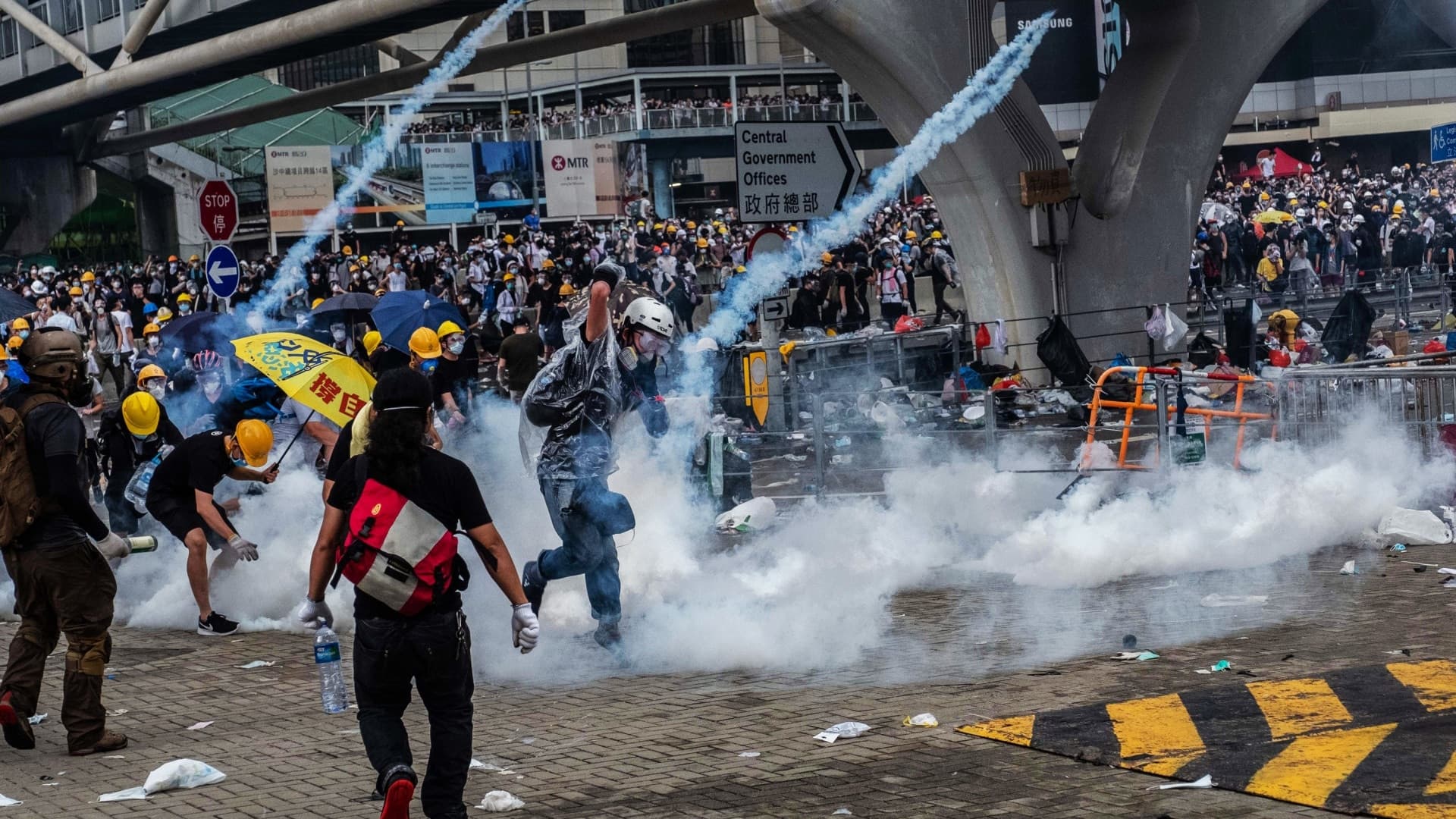
Over these past few weeks, the whole world has seen the strength of Hong Kong's spirit. We give ourselves to what is right without a second thought; in the face of danger we do not yield an inch. I came across a short clip online: after the police fired rubber bullets, the protesters were shaken — yet within moments they regrouped, rallied one another, and pressed forward again towards the police. Our fear of losing our lives is no match for our love for this city, so much so that, in that moment, people were willing to set life and death aside and give everything for their home.
Softness is not the opposite of strength – they are both part of love
After this round, the government gave a little ground and suspended the extradition bill. Most of us could breathe a momentary sigh of relief — but the oxygen in that breath was so thin it was barely enough to live on, because we all knew the root problems remained: an authoritarian political system, a corrupt police force, none of it resolved. As long as these problems persist, history will keep repeating itself, and the brave will have to keep bleeding.
What follows is a wave of powerlessness, and beneath that powerlessness, the hurt slowly surfaces. We begin to feel self-blame, softness, despair. At this point, strength itself becomes our burden – why is it that the people of Hong Kong, who once came together as one to build this city, are now, as a collective, weeping alone? We even cannot help but blame ourselves: are we, in our softness, still strong enough to protect Hong Kong?
But think about it carefully — aren't strength and softness two sides of the same feeling for Hong Kong? If we did not love Hong Kong, how could we brave such danger and press on regardless? But if we love Hong Kong, how could we watch her be harmed and feel nothing at all? People are like hedgehogs: the soft underbelly guards what must be protected, while the hard, sharp spines fend off the enemy at the gates.
So stop blaming yourself for having a softer side. Softness is not opposed to strength; it is part of the whole of love. From 1997 to today, we have cried, we have ached, we have been soft — and haven't we always managed to walk through it in the end?
Learning to accept your own emotions
Research shows that in the face of violent situations, a good many people will develop Post-Traumatic Stress Disorder — soldiers among them[1] — at rates that can reach as high as one in five. The main symptoms include the images of that time surfacing in the mind again and again, intense feelings of depression or anxiety, and a failure to return to normal for a long time. Concretely, you may find yourself unable to stop watching footage of the police using force, and so on…
Victor Frankl, the psychologist once taken into a concentration camp during the Second World War, once said: "An abnormal reaction to an abnormal situation is normal behaviour."[2] So if the recent situation in Hong Kong leaves you feeling unable to breathe, that is only human. You need not blame yourself for it, because there is nothing wrong with you.
Another very common situation is forcing yourself to clear away every negative emotion and pull yourself together at once, or telling yourself you ought not to feel happy, because Hong Kong's ordeal is not yet over and out of regard for those who have fallen. But emotions are not like a stone you can simply shove further away the harder you push. Forcing yourself to control your emotions usually achieves the opposite: what began as feeling low over some particular thing turns into feeling low because you cannot control feeling low.
There are only things we ought not to do; there are no emotions we ought not to have.
Do not shy away from looking after your own psychological needs
So what, concretely, can help you accept your emotions? One method is to imagine yourself as an onlooker watching your emotions: as an onlooker, our intention is only to observe the emotion, not to control it. You can even say to yourself, half-playfully: "Let's just see how heartbroken you can get!" This may sound a little counter-intuitive, but because it stops you from forcing your emotions to be one way or another, it can be a real relief in practice.
This simple method and the now-popular practice of mindfulness (Mindfulness) rest on the same set of principles: meeting negative feelings Non-Judgmentally – that is, not trying to control the coming and going of emotions, but instead exploring every dimension of them with an Open & Curious attitude. In times like these, when things may feel hopeless, mindfulness is also a good way to help you make sense of your feelings, your aims and your thoughts. A number of organisations in the city offer mindfulness sessions, each with its own character; friends who feel the need might like to find out more. If the difficulty reaches the point of real distress, then reach out for help from professionals who deal with mental illness, such as social workers or clinical psychologists.
Looking after your own emotions is not weakness — and even if it were weakness, what of it? There is a time to advance, and there is also a time to step back from the front line and tend to yourself, because this is a long struggle, and it does not depend on everyone draining all their energy in a single moment to get the job done.
We have all been hurt. To choose to carry your wounds into battle and resist to the last is, of course, lofty and worthy of respect; to choose to step back from the front line for a while and let your wounds heal is wisdom in action. Even if, for you, the hurt is too great to bear and you choose to leave the protest movement — you have already given Hong Kong all you can give, and you owe nothing to this land for the kindness it has shown you.
Whatever your choice, we belong to this fine people all the same. We support you, we believe in you, and we ask that you treat yourself well too.
[1]https://nvf.org/veteran-mental-health-facts-statistics/
[2]“An abnormal reaction to an abnormal situation is normal behavior.”
Image source: The New York Times



Comments
No comments yet — share your thoughts.