Why We Can't Let Our Things Go
Hong Kong homes are small, and decluttering has become almost a household creed. Yet every time we face a cupboard packed to the brim, letting go feels strangely difficult. Psychology explains why we…

Hong Kong homes are small, and decluttering has become almost a household creed. Yet every time we face a cupboard packed to the brim, letting go feels strangely difficult. Psychology explains why we…
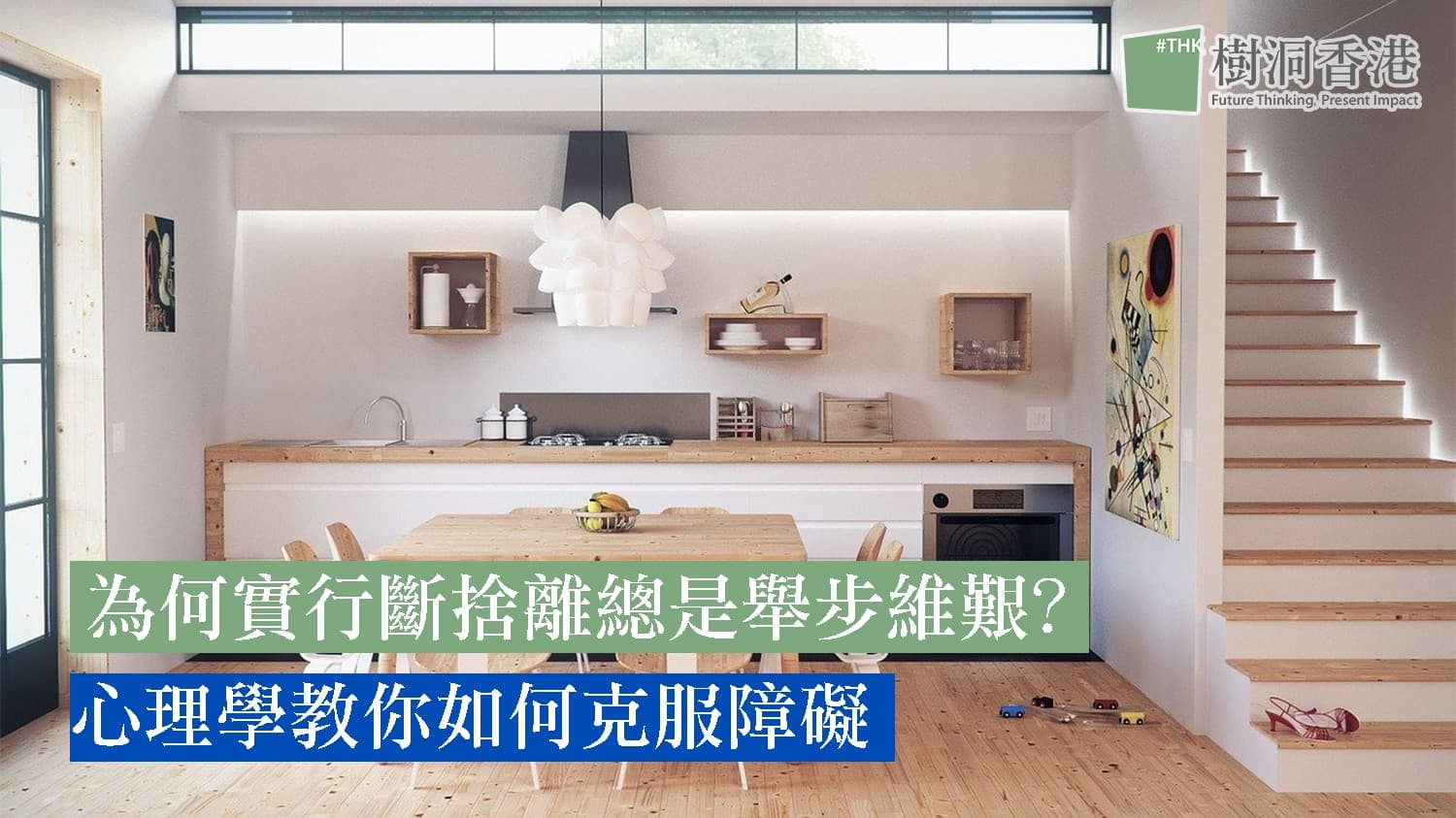
Hong Kong is a city of soaring rents, where living space is almost universally cramped, so books and TV programmes that teach us how to make the most of our home storage are hugely popular. In recent years the philosophy of "danshari" (the Japanese practice of refusing, discarding and detaching) and "minimalism", championed by the likes of Japanese authors Hideko Yamashita and Marie Kondo, has enjoyed a moment of real prominence in Hong Kong — to the point that it seems to have become the golden rule for the ideal home of today. With COVID-19 ravaging the whole city in recent months, Hongkongers have been spending more time at home, leaving us without the usual excuses of being "too busy" or "having no time" to tidy away the clutter. And yet, every time we open a wardrobe, bookcase or kitchen cabinet stuffed to bursting, do you ever feel you have no idea where to begin, and abandon the thought of tidying the whole room altogether? Why do we have a tendency to cling to old possessions and resist "letting go"? Is there any method at all that can improve the habit of hoarding, while letting us enjoy the comfort and beauty that simplicity and tidiness bring?

Put simply, hoarding refers to keeping objects of one or various kinds in the home over a long period, where every attempt to discard the clutter (even when, objectively, the item has little remaining usefulness) is met with a welling-up of psychological resistance (emotional stress) that leaves the person unable to move forward. Everyday experience is enough to show that ordinary people generally find it difficult to "let go", believing an item has "collectible" or "sentimental" value, or that it might come in handy one day; the difference is only one of degree, and in that sense it is simply part of being human. When the habit of hoarding is taken to an extreme, however, it becomes "hoarding disorder". According to the American Diagnostic and Statistical Manual of Mental Disorders (DSM-V), hoarding disorder is classified as a type of "obsessive-compulsive disorder", encompassing (but not limited to) the following behavioural tendencies:
According to research from Johns Hopkins University in the United States, around 4% of Americans suffer from hoarding disorder — that is, one in every 25 people is a hoarder. Extrapolating from this figure, Hong Kong too would have close to 300,000 sufferers. Excessive hoarding affects not only the beauty and comfort of the home; it can also more readily lead to hygiene problems and fire hazards. In Britain, someone once hoarded clutter so excessively, both inside the home and in the back garden, that it caused a serious rat infestation in the neighbourhood, and the person was eventually ordered by the government to clear it by force — at a cost of more than £60,000! This goes to show that the social cost caused by hoarding disorder is not necessarily lower than that of other, more "mainstream" mental illnesses (such as depression or anxiety disorders).

Cognitive-behavioural approaches attribute hoarding disorder to deficits in the person's cognitive abilities (such as executive functions, sustained attention and categorization), indecisiveness, and cognitive bias, which leave them unable to sort their clutter normally into useful or useless, and therefore unable to "let go". Unfortunately, the greatest limitation of this approach's explanation is that it does not account for why a person invests such intense emotion in objects (or "inanimate objects"), making it so hard to part ways with them.
A different school of psychology, founded by the neurologist Sigmund Freud, who probed deeply into the individual unconscious, takes a different angle: the focus of psychoanalysis falls on how past experience (especially in childhood) shapes the development of personality. In particular, Freud's "psychosexual theory of development" holds that the development of one's personality is determined by childhood experiences before puberty (pre-puberty); different age ranges correspond to different development stages, and the way parents handle their child-rearing at each stage bears a profound relationship to the child's later growth and personality. Children aged 2–4 are in the anal stage of development: the source of "pleasure" (which psychoanalysis calls the erogenous zone) shifts from the oral stage of the mouth at birth to the anus, since this is just when their sphincter (the anal muscle used to control excretion) begins to mature, and they derive "pleasure" through the release of feces. Moreover, because feces are their first "product", they treasure them especially, and so they also have a tendency to "hold on to" (possession) their feces (note: at this age children do not yet have the concept of "dirty"). Karl Abraham, a member of Freud's research circle, later added that, through the discipline parents subsequently impose, children come to understand that playing with feces is socially unacceptable, and so "saving and possessing" other objects becomes a substitute for saving excrement. This, he suggested, is how we develop the habit of holding on to things.

Later, the British paediatrician and psychoanalyst Donald Winnicott argued that, every time a newborn cried, the mother would always feed it (especially through breastfeeding), so that the mother's breast became the source from which the infant obtained "pleasure" and a sense of safety. What is more, because of the mother's "high responsiveness", the infant has no distinction at all between "self" and "other", or between itself and "external reality"; it believes itself to be "omnipotent", with the mother as part of the "self". Later on, as the mother (the primary caregiver) cannot always be "highly responsive" — for example, needing to work and so unable to attend to the child's needs at all times — the infant begins to become aware of the distinction between "self" and "external reality", that the mother is no longer part of the "self", as when no one comes to attend to its needs after it has cried for a while. To help the "self" gradually adapt to this "cruel reality" during this stage, the child (roughly 18 months to 4 years) will seek out a substitute to stand in for the mother's role (usually something softer or fluffier, such as a doll, a handkerchief or a blanket); this object is called a "transitional object". Because the "transitional object" lies somewhere between the "self" and "external reality", the object to some degree both represents the mother's qualities and her care, and also represents a part of the "self". The child therefore invests a great deal of emotional attachment in the object, and the object can also serve a soothing function for the child. It is worth noting that, at this stage, once a child is deprived of or loses its "transitional object", it is as though it has lost a part of "itself" — which explains why we become attached to objects and habitually struggle with "letting go". Interestingly, some people still carry around, or occasionally bring along, a "transitional object" from their early years even after they have grown up; the late Italian tenor Luciano Pavarotti, for instance, would sometimes take the same handkerchief with him when he performed.

Bowlby's attachment theory points out that the relationship a child builds with its caregivers (especially the mother) has a far-reaching influence on its later sense of safety, personality, and the way it forms intimate relationships (its "attachment style"). If caregivers cannot consistently provide a child with appropriate care and attention, the child will tend to lack a sense of safety as it grows, and to develop a poor "attachment style" in adulthood — for instance, an "anxious attachment style". In intimate relationships, such people crave closeness, and so often sacrifice their own needs to make their partner happy; and when rejected by someone they treasure or long for, they often endure greater psychological pain (pain perception), which is why they tend to invest excessive emotion in objects and draw more of a sense of safety from them, to compensate for the emptiness and loneliness within. This, to some degree, explains the formation of pathological hoarding disorder.
:max_bytes(150000):strip_icc():format(webp)/attachment-styles-2795344-v1-5c61db3346e0fb0001ca8cb1.png)
Type the keywords into the internet and you will find that mainstream media often use the "broken windows theory", the "birdcage effect" or the "flywheel effect" as a way in, encouraging people to think twice before buying, to buy only what they need, to keep the home simple and tidy from the outset, and to ask "do I really need this?" when picking things up — all as a way to practise "letting go". I wholeheartedly endorse how useful these approaches are, and recommend them to everyone. For what it is worth, the following four methods may also be worth a try:
One major reason so many people put off actually "letting go" is that they hold on to a "it might still be useful someday" mindset and remain indecisive. It is therefore essential to set clear, concrete criteria for "letting go": apart from items of special sentimental value (such as photo albums, gifts from a loved one, or trophies), everything else should be dealt with by a uniform standard. The criterion I would personally suggest should include "anything not used in the past three years" — because if it has gone unused for the past three years, the chances of suddenly needing it in future are vanishingly small, which breaks the spell of the "it might still be useful someday" myth;
Another way to save space at home is to replace three-dimensional objects (3-D) with flat ones (2-D) wherever possible. For example, when someone has hoarded hundreds of books over the years and packed the room solid, and is struggling over whether to discard them, a workable approach is to scan every book, then upload the scanned files to a computer or e-reader. This overcomes the "I might still want to read it someday" mindset, so the resistance to "letting go" is reduced;
Throwing away the clutter you once hoarded amounts to a genuine "loss", and on an emotional level everyone feels this more or less keenly (however different reason and emotion may be). If you can find a friend to "take in" these items, however, this is in fact a compromise that involves less psychological resistance and is easier to accept. Because, on an emotional level, you will think to yourself: "I haven't really thrown it away; I've just given it to someone else" (though, of course, you first have to find a friend willing to receive it). When I was at university, I would now and then see members of teaching staff who were about to leave place the books from their office outside the door and give them away free to passing students; I imagine this was probably the reason why;
The greatest obstacle to "letting go" is none other than the emotion we invest in being "attached and unwilling to part" with our possessions. This reflects a "complex" within us that we have yet to fully process or overcome, and at times the experience makes us recall events and feelings from the past — for instance, certain "farewells" or "losses" in the past for which we were not psychologically prepared. If you have been through something similar, my suggestion is to hold a simple, sincere "ritual of farewell" for the imminent "letting go" — such as taking a photo with the item, or writing it a letter — to let us feel more fully prepared to accept the parting.

Although psychoanalysis can hardly help giving people an impression of "pan-sexism", or even of being "deviant", psychoanalytic theory has undeniably offered a comprehensive, illuminating and far-sighted interpretation of, and deep inquiry into, phenomena that are fundamental to many people's nature. As the saying goes, "meeting is hard, but parting is harder still"; each act of "letting go" is undoubtedly an unpleasant tug of war. And yet, just as "people know joy and sorrow, parting and reunion, and the moon waxes and wanes", it is our own inner adjustment that anchors us as we weather life's heaviest challenges. "Letting go" is not merely about learning to "keep house"; it is, even more, a philosophy of life.
Finally, two lines from Eason Chan's song "Under Mount Fuji" run: "Everyone has only that pair of hands; even an embrace is hard to hold, let alone to possess; to possess you must first understand how to accept loss." In a society rich in material comforts, satisfying our material desires is not difficult — but what does it truly mean to "possess"?
Keefer, L. A., Landau, M. J., Rothschild, Z. K., & Sullivan, D. (2012). Attachment to objects as compensation for close others’ perceived unreliability. Journal of Experimental Social Psychology, 48(4), 912-917.
Steketee, G., & Frost, R. (2010). Stuff: Compulsive hoarding and the meaning of things. Houghton Mifflin Harcourt.
Yap, K., & Grisham, J. R. (2019). Unpacking the construct of emotional attachment to objects and its association with hoarding symptoms. Journal of behavioral addictions, 8(2), 249-258.
Keep reading

Psychology
Personal Growth
Psychology



Comments
No comments yet — share your thoughts.