The Reflection That Goes Beyond the Surface
Reflective essays have no fixed framework, which is exactly why they leave so many students lost. Drawing on two models of reflective practice — and years of marking these essays — here is how to mov…



Reflective essays have no fixed framework, which is exactly why they leave so many students lost. Drawing on two models of reflective practice — and years of marking these essays — here is how to mov…
The ancient Greek philosopher Socrates once said that “the unexamined life is unworth living”; in China, Zengzi wrote in the Analects • Xue Er: “Each day I examine myself on three points: in acting on behalf of others, have I been faithful? In dealings with friends, have I been sincere? Have I practised what was passed on to me?” His intent was to urge us all to think often about how we might do better — in our studies, in our careers, and in our relationships with others.
The overwhelming majority of human-centered professions (such as teaching, speech therapy, counselling, social work and the like) build their training around experiential learning, cultivating in students the capacity for personal reflection after professional practice, so that they keep refining their craft within their field. For this reason, all of these programmes ask students to submit a reflective essay after their placement.
When I was studying counselling myself, a great pile of reflective essay assignments often left my head spinning. They had no fixed framework, and from primary school all the way to university I had never been formally taught how to write one — so every time I sat down to write one, I worried far too much about whether what I had written would “ruin the grade” (turning thinking out of the box into thinking out of the grade). In what follows, I will introduce two theoretical frameworks for reflection and share some techniques for writing a reflective essay that stands out.
Over the past century, scholars have defined “reflective practice” in slightly different ways, but they all agree that reflection offers an essential space for improving our professional practice. Reflection lets us examine our own behaviour, emotions and thinking while we are practising professionally, serving the purposes of self-awareness and self-monitoring.
That said, how useful this turns out to be depends largely on whether a student can actually reflect with “depth”. So what counts as reflection with depth? Below is the deep-reflection theory put forward by Korthagen (2004) (Onion model of reflective thinking).
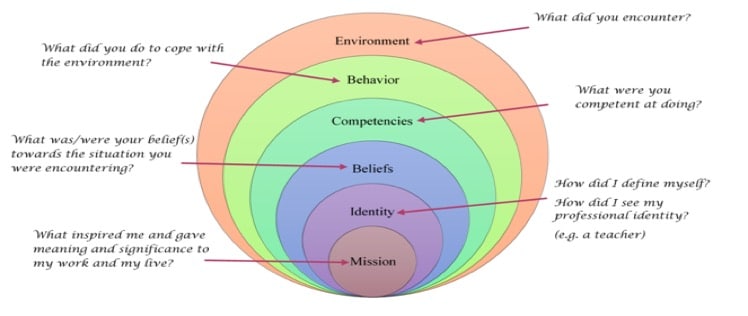
Korthagen argues that shallow reflection amounts only to describing one’s immediate environment and all the people and events in it (oneself included), whereas the ultimate aim of reflection should be to connect the experience of the moment (people and events included) back to an examination of one’s own values & beliefs, identity and sense of mission.
Next, let us look at the tiered framework of reflection from Bain et al. (2002).

Within this framework, Bain et al. (2002) divide students’ reflective writing into five levels.
The first two levels (reporting and responding) consist only of an account of the surrounding environment during the placement, the people and events nearby, and one’s own feelings in the moment;
A slightly higher level of reflection (the third) includes briefly pointing out how a professional theory or technique was applied during the placement, and its effect — for example, a counselling student noting that they used open-ended questions with a client, prompting the client to share more of their past experiences of growth (the corresponding effect);
The fourth and fifth levels of reflection involve analysing “other potential factors that might affect the outcome of the professional service”, pointing out the limitations of the professional theory or technique applied in the moment, and specifying how, after such a process of reflection, one might “elevate” one’s own practice. For example, in a particular individual counselling session, the counsellor drew on person-centered therapy to help the client work through their own problem (for example: should they divorce their spouse?).
But after the session, the counsellor realised that the person-centered approach leans towards considering the client’s own emotional needs, and that relying too heavily on this therapeutic theory might neglect the client’s “collective” circumstances — especially when the client lives within a Chinese society that places great emphasis on collectivism (for example: once a divorce is proposed, how great will the conflict be for themselves and their family?). And so, in later counselling sessions, the counsellor decided to approach the work and joint exploration from the angle of the client’s “collective” or social dimension, in order to attend to the client’s needs in the round. Next, I would like to share some deep-reflection techniques that school rarely (or never) teaches you:
First of all, I am not asking students on placement to discard every professional theory in the course of reflection; rather, I want students to recognise that every theory has its limitations. A traditional theory only points to the relationship between one variable and another — for example: a counsellor can improve certain positive behaviour in a client through positive reinforcement. Yet a client’s own history of growth and cultural background may both affect how well a given theoretical approach works, and a textbook will not spell out, one by one, how the same theory should be applied in different situations. For this reason, I encourage students on placement to think a little about how a client’s internal and external factors shape the effectiveness of a professional intervention, and, after such analysis, to point out how to transform their intervention techniques in future — gradually developing a distinctive set of intervention techniques and approaches of their own.
The term “metacognition” was coined by the American psychologist John H. Flavell. Put simply, it refers to the capacity to recognise clearly the inner reasons behind our own behaviour, emotions and thinking. Our words and deeds (including how we intervene during a placement) are in fact shaped by an inner system of beliefs or philosophy (see Korthagen’s Onion model of reflective thinking above).
To put it another way, through the capacity for metacognition we can come to understand this system of beliefs, and that helps us improve the way we carry out a professional intervention — which is, likewise, a process of deep reflection.
For example, a teacher on placement often resorts to shouting to keep order in the classroom. Yet shouting is not effective, and before long the students grow noisy again. This teacher, full of a sense of helplessness, later met with their supervisor, and in the course of that meeting the trainee teacher realised that their habit of relying solely on punishment to manage classroom order might stem from their own upbringing — an experience of facing constant criticism without being given enough encouragement. And so this trainee teacher recognised how their past experiences had constrained their way of handling things, and went on to analyse and try out different responses for dealing with the same kind of incident.
Conclusion
Reflective essays have never had a fixed format or arrangement of content, and the marking criteria can seem rather subjective. Yet in truth, an excellent reflective essay is inseparable from the elements of deep reflection described above. In my past research work I have found that the great majority of students on placement reflect only at levels one to three of the Bain et al. (2002) framework. I therefore hope this piece will help fellow students studying a professional discipline take their reflective writing to a higher level.
If you are interested in counselling, you may like to read the following articles:
【Counselling】About Counselling: 6 Things You Need to Know, To Aspiring Students of “Counselling and Psychology”, An Introduction to TreeholeHK’s “Counselling and Psychology”: Five Things You Should Know
Bain, J. D., Ballantyne, R., Mills, C., & Lester, N. C. (2002). Reflecting on practice: Student teachers’ perspectives. Post Pressed.
Flavell, J. H. (1979). Metacognition and cognitive monitoring: A new area of cognitive–developmental inquiry. American psychologist, 34(10), 906.
Korthagen, F. A. (2004). In search of the essence of a good teacher: Towards a more holistic approach in teacher education. Teaching and teacher education, 20(1), 77-97.



Comments
No comments yet — share your thoughts.