Why Fighting Stage Fright Backfires
Standing on stage, my heart pounds and my palms turn clammy. But contrary to popular belief, that anxiety can actually make me a better speaker — if I stop trying to shake it off. Here is the simple …



Standing on stage, my heart pounds and my palms turn clammy. But contrary to popular belief, that anxiety can actually make me a better speaker — if I stop trying to shake it off. Here is the simple …

Sometimes, standing on stage and speaking, my heart pounds like a drum. The audience may not be able to tell while I'm talking — but do you know what frightens me most? Now and then I have to shake someone's hand, and I know that palm, soaked in sweat, is as clammy as a freshly caught fish.
But contrary to popular belief, anxiety can actually make you a better speaker.
The reason people feel anxious is a survival mechanism shaped by evolution. Picture this: for our distant ancestors, being the focus of many pairs of eyes was rarely a good thing — it might mean a predator had locked onto you.
When we feel anxious during a talk, the sympathetic nervous system is activated. The heart beats faster, which sends more blood to the brain, and that in turn makes us more alert and sharp — boosting how fluently we can express ourselves.
According to the arousal curve model, even for a task as difficult as public speaking, people need a certain level of arousal to reach their best state. As the Yerkes–Dodson law shows, being too relaxed and being too tense are both less than ideal.
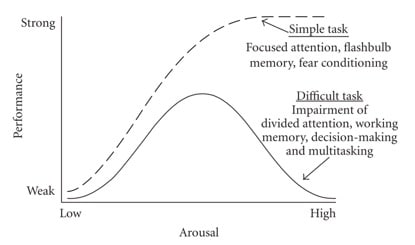
So where exactly does it go wrong? The truth is that we handle anxiety the wrong way — we always try too hard to shake the anxious feeling off. Humans are social animals. We're afraid of saying the wrong thing. We're afraid of being judged and picked apart when we speak. That is the source of our anxiety; it is simply human nature.
Feeling anxious in these situations is like salivating in front of a delicious meal — it's a response we're all born with. These innate reactions can't be controlled, and shouldn't be controlled either. When I stand in front of a crowd, I don't force myself to chase the anxious feeling away. Because that would be like trying to keep my mouth dry while imagining a big, sour plum — it simply can't be done.
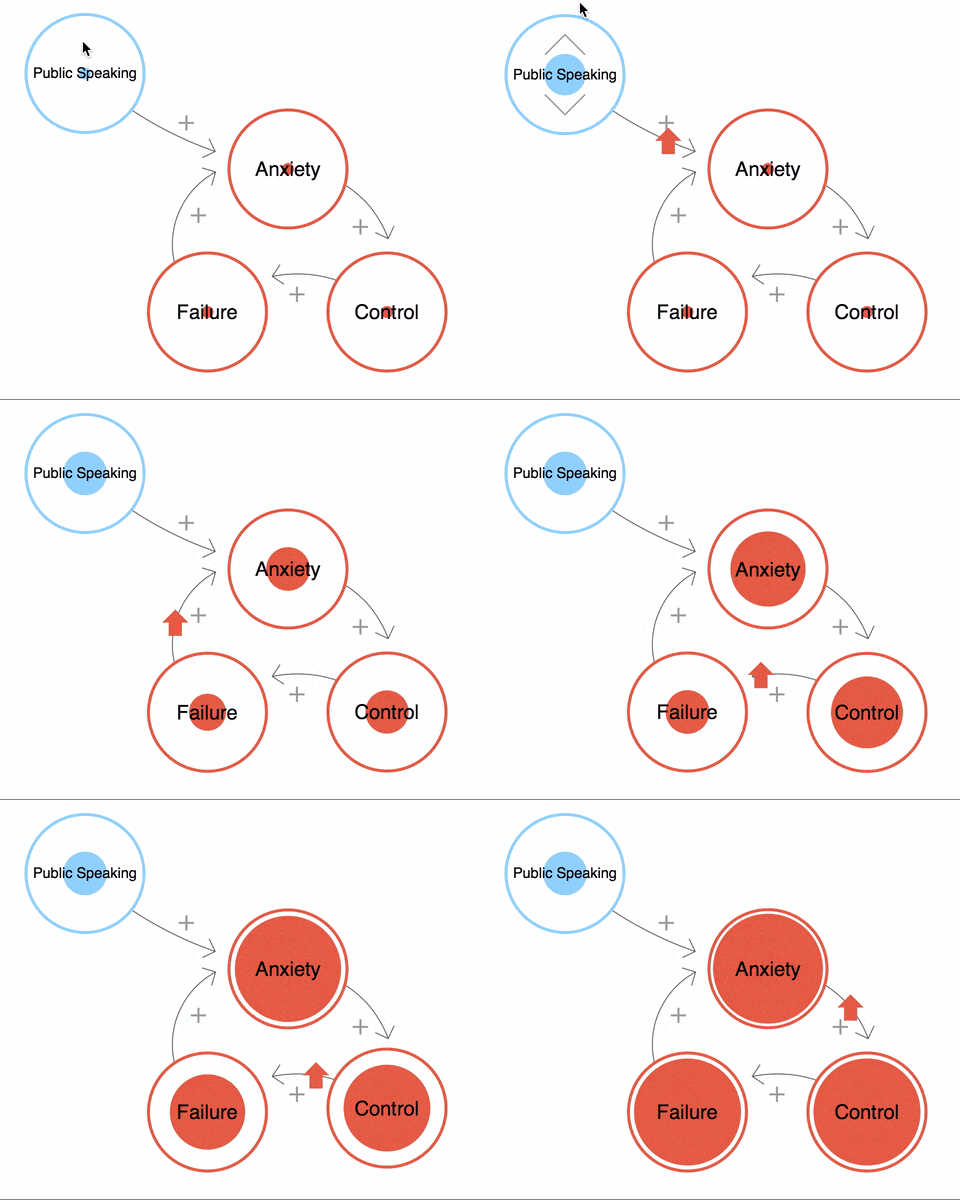
The very urge to shake off the anxiety is what creates the problem. If I can't suppress my worry, I grow even more anxious about the failure that might be coming. The more anxious I feel, the more I want to shake the anxiety off, and on it goes. This forms a vicious cycle (as the diagram shows), with the arousal level climbing step by step, far past the optimal state, into a worse one — sometimes even climbing to a point beyond saving. That's when the mind goes blank and the tongue ties itself in knots.
We can deal with anxiety using a skill we're already very good at: letting the mind wander.
I'd guess everyone knows just how good we are at letting our minds wander. For a student, paying full attention in class is next to impossible. Most of the time, my attention would only rest on the teacher for a fleeting moment. When we try to focus on something we're not really invested in, the mind is bound to wander.
So why not face anxiety with the very same approach? Notice it, rather than trying to shake it off.
What is the rhythm of that thump-thumping heart? What is the texture of those sweat-soaked palms?
The key is to notice these subtle physical sensations, not to dwell on them. Of course, that doesn't mean forcing yourself to stop thinking about them entirely. Thoughts like "my palms are too clammy" are free to drift through my mind. If that happens, I simply notice the thought and let it fade away on its own.
Now that the theory is covered, it's time to talk about how to put this method into practice. Before every talk I give, I run through the following brief mindfulness practice. If you can't wait to give it a try, recall a stressful situation as vividly as you can, then follow the steps below — or try the [Breath Awareness Meditation] in our guided mindfulness audio recordings.
Step 1 — Feel yourself
I find a comfortable posture and sit down in a chair. Then I close my eyes and begin to breathe deeply, slowly observing every sensation flowing through the body. You can try to observe:
– What does my body feel?
– What am I thinking about?
– What emotions do I have?
You can spend some time on this step.
Step 2 — Focus on the anxiety
Now, gradually shift your focus to the part of the body where the anxiety lives.
Perhaps it's the thump-thumping heart? Or the quick, hurried breath? Or the sweaty palms?
Whichever it is, try to observe them. Stay curious about them, as if you want to understand your body a little better. Observe how the anxiety affects you.
Step 3 — Shift
Finally, open your eyes and start to observe the surroundings.
Ask yourself: What do I hear? What do I see? Then I keep shifting my awareness, staying clear-headed, right up until I deliver my talk.
This kind of mindfulness practice is like a gym for the mind — it takes training. Although this simple skill helps with public speaking, it won't transform us overnight into the perfect speaker. Rather, it takes ongoing practice to make steady, incremental progress.
Practising meditation more often brings many benefits. It has made me a happier and less anxious person, and these benefits show up after you genuinely commit to trying meditation. The benefits meditation brings — such as greater wellbeing and relief from anxiety — are all scientifically proven. Practising mindfulness has been one of the best decisions of my life, so I sincerely recommend giving it a try.
For more detailed information on mindfulness, you can read another article of mine: [What Is Mindfulness? The Psychological Training Embraced by Google and Goldman Sachs]
Keep reading
Mindfulness
Mindfulness
Mindfulness


Comments
No comments yet — share your thoughts.