

Life in Hong Kong piles on the pressure,
and so a steady stream of mind-body activities and courses has sprung up in response.
Rooted in Buddhism, meditation and stillness,
which psychologists found four decades ago could help improve mental health,
have since grown into a systematic programme of psychological training,
and gradually become a movement.
Yet for the Hongkonger who is hustling every minute of every second,
even a few minutes of deep breathing already feels like a luxury.
To promote meditation,
two people born in the 90s founded a psychology-promotion organisation called "Treehole".
What they teach is the simple wisdom of slowing down.
"Hongkongers are rushed about everything; they can't sit easily in the present moment.
Sometimes, when you slow down, and you become 'aware' that you are slowing down,
you discover just how much you needed these moments."
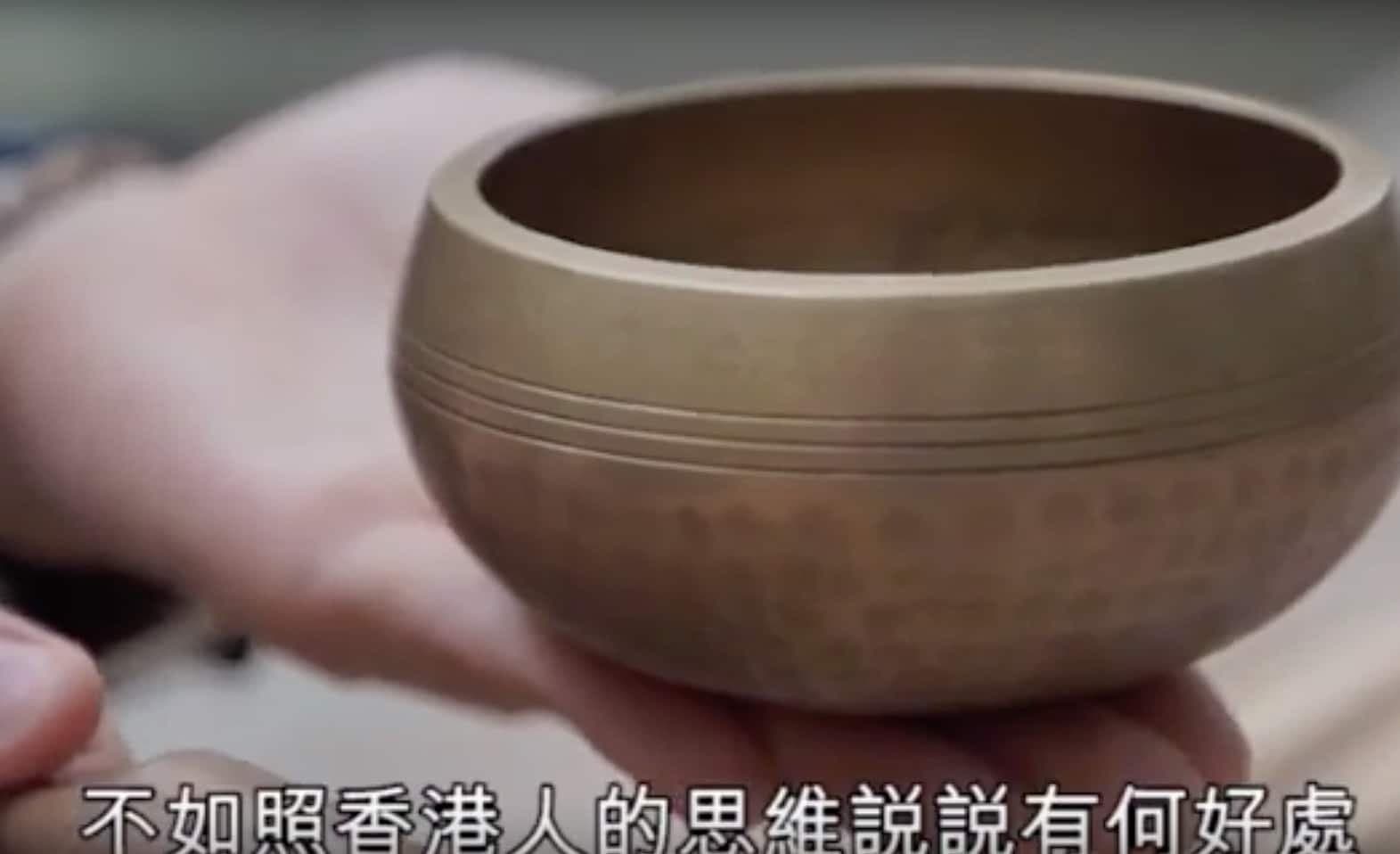
A bell is struck softly, and a calm tone rises and lingers, winding and circling through the air. No one speaks. Cradling a bowl that holds a single green grape, each person first lifts the grape gently, then lowers their gaze to study the speckles and the play of light across its surface, before moving it to the nose to take in its sweet fragrance. At last it is placed in the mouth, where the difference in texture between skin and flesh can be felt, layer by layer. As it is chewed slowly, the fruity scent fills the space between the teeth and the cheeks before spreading further. At this moment, the bell sounds again. Drawn out of the tangle of their thoughts and back to reality, everyone finds the world suddenly as clear as a mirror; things ordinarily overlooked unfurl before the eyes like a scroll — "so a grape is a little translucent, with many tiny dark spots", "so a grape isn't round, but has slightly angular edges and dips and bumps".

"When you take the time, through touch, sight, smell, and then taste, to experience the whole process of eating a grape in detail, you will notice many things you usually never pay attention to."
This is one segment of meditation and stillness training — mindful eating. The instructor, Peter Chan, tells the participants: "When you observe your present-moment experience carefully, you'll find that there are usually many things people overlook. Take dessert — usually we eat it while chatting with others, but rarely do we put our full attention on the food itself. Yet when you take the time, through touch, sight, smell, and then taste, to experience the whole process of eating a grape in detail, you will notice many things you usually never pay attention to."
To be still, to be slow — to Hongkongers this seems almost inconceivable, let alone over something as "inconsequential" as eating a grape. "Hongkongers are rushed about everything; they always have to chase a goal, and can't sit easily in the present moment. Sometimes, when you slow down, and you become 'aware' that you are slowing down, you discover just how much you needed these moments." With his army crew cut and plain clothes, Peter is only 23, yet in both appearance and manner he seems more mature and quietly wise than his peers, rather like a learned monk who has lived in seclusion since childhood — calm and at ease with himself.
As it turns out, Peter was once a pessimist too. "I was never very happy growing up, always a bit grey, never quite satisfied with life." Having graduated last year from HKU's psychology department, he found his emotional troubles flaring up even more two years ago, when he went to Oxford in the UK as an exchange student. "I wasn't really adapting to the local cultural environment back then, there were problems with my social life, and the academic pressure was heavy too." He decided to sign up for Oxford's meditation workshop, where, under the guidance of an experienced instructor, he trained in meditation through sitting practice and focused breathing. For someone who had always been impatient, learning to settle his mind was no easy feat, but after a good while of practice, Peter gradually felt a change. "Sometimes I'd be walking in a park, not feeling all that happy to begin with, but then I'd realise there was green grass and sunshine for me to appreciate, and my stress eased off."
From then on Peter threw himself into learning meditation, visiting Thai temples and studying under Hong Kong psychologists. Now, besides meditating for 15 minutes each morning and evening, he also meditates on the MTR. "Once I was on the East Rail line and the passenger next to me kept jiggling both legs, which set my legs jiggling too. So I started meditating, and meditation means paying attention to the breath, so I paid attention to the sensation of him jiggling my legs, and then the irritated feeling just disappeared." Beyond steadying his emotions, Peter feels meditation has also made him more resilient and content. So half a year ago, the freshly graduated 22-year-old joined forces with Ronald Tong, then 22 and a fresh social sciences graduate from Shue Yan University, becoming business partners and founding the psychology-promotion group "Treehole", hoping to improve Hongkongers' mental health through psychology and stillness meditation.
Meditation has always carried an air of solemnity and stillness, so how, in the bustle and clamour of Hong Kong, could one ever find a secluded mountain retreat far from the world in which to "renounce the world"? Peter, however, believes that sitting practice is just one form; meditation is in fact not bound by time or place and can be done anytime, anywhere. "Meditation can actually be very everyday, because at root, meditation is the training of observing your present-moment state just as it is. As long as you are aware of the present-moment sensation, you are already meditating." Breathing is a state to be noticed; so are walking and talking. Beyond sitting practice, Treehole has also run plenty of life-integrated meditation training, such as "mindful walking" — climbing a mountain with a meditative mind, taking in the nourishment of nature and the calm within; and "mindful mushroom cooking", where, while preparing food, one practises observing the texture of the ingredients and every movement of the cooking with a clear mind.
Treehole has also run an "MTR Meditation Workshop", playing a soundtrack recorded with the noise of the MTR so that participants imagine themselves on the train, then learning, with eyes closed or eyes slightly open, to pay attention to their own breathing, as a way of training themselves to coexist with a noisy environment or with their emotions. "It's like when the phone rings — you very naturally feel you must answer it. But meditation practice lets you be aware that this sound has appeared, while in the end whether or not you answer the phone is your choice. In that process it gives you a space to think about whether you really have to be dragged along by the sound."
Peter then led the reporter through a five-minute first-time experience of MTR meditation. As the bell sounded, following Peter's gentle, affirming instructions, the reporter sat cross-legged with eyes closed, breathing in and out, tensing and releasing — and by the time the eyes opened again, a fair amount of tension had indeed eased. Yet in those short five minutes there was already some restlessness in sitting still, with many jumbled, chaotic sounds drifting through the mind, a far cry from the state of "sudden insight" one might have expected to reach. "I feel Hongkongers seem to want a set right answer for everything they do; even while meditating they'll think: what should I be thinking now? What state should I be in? What realm should I reach? But it really isn't a matter of demanding a 'realm' for everything." Many meditation beginners also find it hard to concentrate during the process, and may even feel low, or that there is nothing special about it. Peter, on the contrary, feels that meditation is precisely about learning to observe and accept all the joys, angers, sorrows and delights of the present moment. "Apart from being impatient, Hongkongers also love to control everything; when things don't develop as expected, they feel they must 'do something about it' — but that can actually bring suffering."
Life in Hong Kong piles on the pressure, and in recent years more and more mind-body activities and courses have appeared. Rooted in Buddhism, meditation was found four decades ago by researchers at the Massachusetts Institute of Technology to help improve mental health, and gradually developed into a systematic programme of psychological training; carried once again from West back to East, it has become a movement. But Peter believes that meditation's bond with religion, hard to sever, has become an obstacle to promoting it in Hong Kong. "Meditation can in fact simply refer to the training of present-moment awareness; it doesn't necessarily have to be viewed through a religious lens, but society still holds certain fixed impressions." Peter recalls a secondary-school classmate who, on learning he now promotes meditation, said to him: "I don't know how to put it to you, but it's as if you've started up some Japanese cult." Ronald, his partner, has likewise faced his family's bemusement: "They'd hear 'meditation' and frown — 'I don't get what you're up to.' So I'd explain again: it's not religion, it's not illness, and they gradually came to accept the activities we run, which are really rather like yoga."

"We just want Hongkongers to enjoy life a little more, because life really has so many beautiful little details — just like a small grape, which can in fact be very sweet."
Yet meditation, a more metaphysical kind of activity, clearly draws less attention than the fitness and yoga that have become so fashionable in Hong Kong in recent years. Looking back on this past half year of promoting meditation, Ronald feels the same. "People who are interested to begin with get really into it, but those who aren't just go to work, get off work, and end of story. A lot of people feel there's no need to pay attention to mental health and personal growth — that it isn't necessary." The two hope to break Hongkongers' fixed impression of meditation: "It can actually be very cool, and you don't only do it when something's wrong."
The two see meditation as rather like fitness training. "Meditation is currently promoted by two camps, Buddhist practitioners and psychologists, but the former lean more on Buddhist theory for their interpretation, which not everyone accepts; the latter emphasise fixing problems, and open by saying meditation helps treat emotional illness, but ordinary people may hear that and think: I don't have an emotional illness, so why meditate? The distinction is rather like the difference between physiotherapy and fitness. Imagine if all day long a crowd of physiotherapists were promoting fitness — people who are perfectly healthy might end up resisting fitness because of it. So we're the salespeople for fitness training: meditation can actually help people build strong psychological qualities, and there's a lot of life philosophy to be learned from it too."
The two once collaborated with the animal-rights group "Save the Hong Kong Pigs" to run a "loving-kindness meditation" activity called "A Send-off at the Slaughterhouse". "Loving-kindness meditation" holds that the gaze between one person and another can foster mutual communication and empathy, and the two applied this principle to animals. More than twenty participants went to the Sheung Shui slaughterhouse, witnessed the butchers whipping the pigs, and, before the pigs were transported into the slaughterhouse, met the gaze of the pigs on the trucks. "Some participants felt, through the pigs' eyes, the animals' fear and despair, and then they cried too." The two believe the activity lets participants reflect on animal rights and the meaning of life, and through meditation, learn to embrace the world's suffering with a compassionate heart, and from there to hold space for themselves, those around them, and all living beings.
This year, Treehole will collaborate with Peter's alma mater, Kei Sze Middle School, to run meditation training courses for the teachers, so that once they have grasped the relevant knowledge they can go on to train the students in meditation themselves. Besides bringing in steadier income for an organisation that the two run entirely at their own expense and risk, the students are also the group they especially want to bring meditation to. "Hongkongers often feel a kind of lostness about life. From childhood we're taught to study hard, get into university, find a good job, get married and have children, then once back at work we long for a holiday, and once the holiday's over we don't want to go back to work — like an endless cycle. Everything happens for a reason, and the problem may well lie in education. Education isn't only about scoring high marks; it also includes cultivating students' emotional management, communication skills and a kind heart, and meditation can serve as a tool of character education too." "Treehole" arrives like rain after a long drought. For the Hongkonger who has faced heavy pressure since childhood, a moment's deep breath may be just that sweet relief. "We just want Hongkongers to enjoy life a little more, because life really has so many beautiful little details — just like a small grape, which can in fact be very sweet." 
Reporter: Chan Hei-yan Photography: Lee Ka-ho, Ho Pak-kai
Originally published at: https://hk.news.appledaily.com/local/daily/article/20190207/20607707


Comments
No comments yet — share your thoughts.