

In recent years, more and more charitable organisations have been swept into scandal. Some donors have discovered glaring discrepancies in the photos of the children their money was supposedly supporting — in some cases the same child reappearing year after year, having never actually grown up. Others, trying to track down the people they had sponsored, have found that the person in the picture had never received a single donation. Each of these revelations stirred up a storm online, with users denouncing the operators for living off the dead and for hiding rot beneath the surface. The public's fury sprang from the fact that their empathy had been exploited for profit: donors are often moved precisely because they see the plight of children in a promotional clip, feel their suffering, and choose to give without a second thought — yet in the end the money disappears into someone else's pocket. We seem to regard empathy as the embodiment of moral goodness, and so this kind of deception feels like a violation of our humanity and makes us angry. It also prompts us to reflect on the role empathy plays in our social life: is empathy really as fine and noble as we believe? In Against Empathy, the author Paul Bloom argues that we may need to look at empathy from another angle.
Rethinking Empathy
To analyse empathy, we first need a precise definition. Empathy means placing ourselves in another person's position and feeling their circumstances and emotions. Traditional moral education has told us that empathy is the root cause of our kindness towards others. People naturally tend to care more about their own needs and desires, and to be most preoccupied with their own pleasures and pains. There is no denying that this is an instinct we rely on to survive; we would not care about others for no reason.
It is the existence of empathy that lets us feel another person's emotions (and this is not merely a figure of speech — as explained below, we genuinely "acquire" another person's feelings). Their suffering becomes our suffering, and only then do we choose to care about them. For instance, the reason we defend the rights and interests of others is, to some degree, that we have entered the inner world of bullied gay teenagers or victims of sexual assault and felt their pain and sorrow; even without first-hand experience of it, we still feel angry enough to step forward.
The author does not deny that empathy can lead to good deeds. From a logical standpoint, however, while a good thing will of course bring about good results, a thing that brings about good results is not necessarily good in itself. A gun, for example, can be used to protect civilians, but in the hands of a tyranny it can also be used to oppress them. We do not call a gun good simply because of the benefits it might bring; we regard it merely as a neutral tool. Against Empathy makes a similar point, arguing that empathy too should be seen as a neutral by-product.
The author begins by analysing empathy from the perspective of neuroscience, arguing that empathy is not the lofty mode of moral reasoning we imagine it to be, but simply a biological process. Research has found that when we witness another person's experience, not only is our visual cortex activated, but mirror neurons also fire indiscriminately, as if we were going through the experience ourselves. In other words, when we empathise with an experience another person is having that is the same as one we have had, the brain activates an identical circuit. (vmPFC)
Psychologists have further found that empathy exists from birth and operates subconsciously, rather than being actively triggered by our thinking. Andrew Meltzoff and his research team found, through experiments, that when an infant watches a recording of another baby having its cheek touched, the same neural response to being touched appears in the watching infant's brain. As they grow older, infants will even imitate the facial expressions of the adults around them, which shows that the mechanism of empathy already exists in an infant's brain even before any moral education. Empathy springs from the natural rhythms of the brain's neurons; it is a reflex action rather than something we do after careful, deliberate thought.

Because of this biological nature, neutral empathy does not in itself give us the motivation to do good. Mirror neurons impart emotion to a person's heart, but this does not mean the person will therefore take positive action — that is, choose to bring about change through good deeds simply because they feel another's negative emotions.
The author gives an interesting example: during the Nazi era, a woman lived near a concentration camp and could see the desperate cries of those inside from her home. So she wrote to the commandant, asking that the site be moved somewhere out of her sight. Rather than lending a hand, a person can just as easily choose to avoid these emotions because they find them distasteful. As long as one stays away from the object of empathy and refuses to witness the suffering, the mirrored emotions will naturally fade away — what people call "the banality of evil".
Conversely, empathy can even become a temptation to evil. A rapist commits the crime partly to satisfy sexual desire, but more likely senses, through the mechanism of empathy, the victim's grief and despair, and derives pleasure from the other person's suffering.
Seen in this light, the effect of empathy is limited to projecting another person's mental experience onto ourselves, becoming a visible and obvious presence that we perceive; in itself it has nothing to do with good or evil. Unlike what we used to assume, empathy is merely one of humanity's ways of perceiving, understanding and communicating with others, not a true moral driving force.
Is Empathy a Demon?
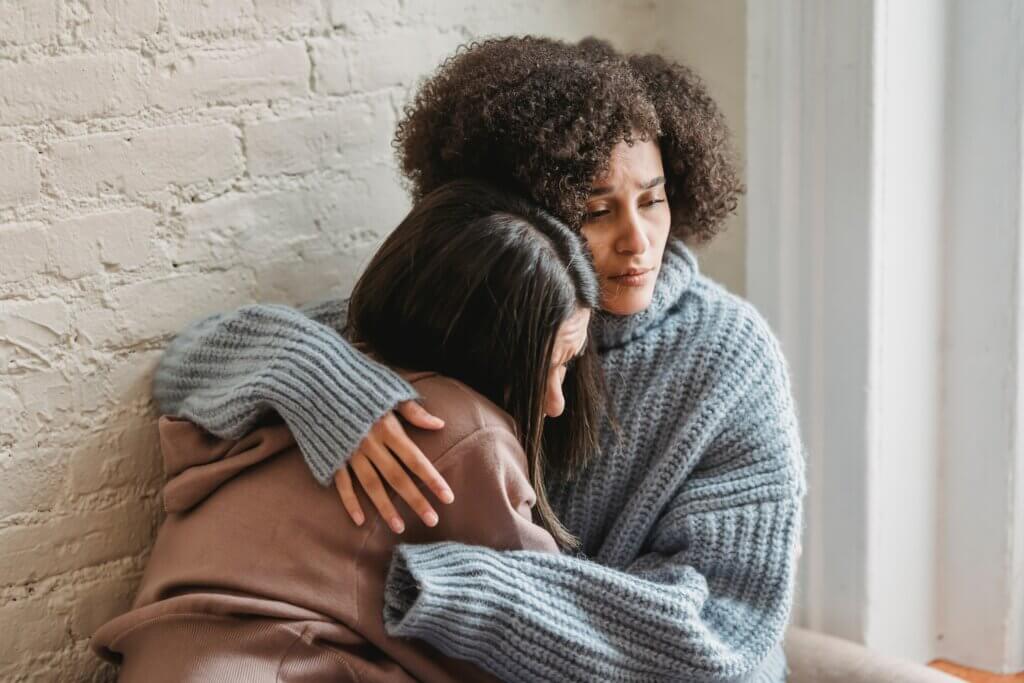
Once we understand the true nature of empathy, we discover that, like any other psychological mechanism, over-relying on or even abusing empathy invites bad consequences. For the individual, empathising with others too much drains the spirit. Everyone has surely had the following experience: a friend, weighed down by an emotional injury, comes to you to pour out their troubles — simply venting about the person they are complaining about and "unloading their burden". The strange thing is that, although it is not you who was hurt, after a torrent of words even you start to feel anxious and exhausted, infected by your friend's negative energy. This happens precisely because, when we care about others, we naturally put ourselves in their place, understanding by experiencing their emotions and thereby helping them. Empathy compels us to keep absorbing other people's emotions, and since the human mind has limited capacity, over time we naturally come to feel drained and find it hard to bear. Paul Bloom asked the counsellor friends around him and found they had the same experience: people who are themselves strongly empathic find this kind of work especially exhausting, which shows that even professionals cannot escape empathy's grip — the very ability to experience another person's mind can instead become a burden on oneself.
Empathy run amok can even interfere with the operating principles of an entire society. Empathy works like a spotlight: when we empathise with a particular person or group, our whole heart is filled with their feelings, so that we can only attend to the object of our empathy in the present moment and overlook the bigger picture. The author points out that empathy can certainly direct our attention to where help and care are needed — for instance, in recent years there have been more and more media reports exposing the plight of people with rare diseases, and the public empathises with them, gives donations and urges the government to improve its policies. But very often the sufferers we empathise with are just a drop in the ocean; many more people whom we do not empathise with endure far greater pain. Empathy's spotlight blinds the public to the darkness beyond the beam, and behaviour driven by empathy may even harm other sufferers, brewing moral injustice (Jonathan Haidt).
C. Daniel Batson conducted an experiment. He told participants that a girl named Sheri was suffering from a terminal illness and was waiting in line for treatment, and let them watch a clip of an interview with her. When asked whether they would move her to an earlier position on the list, most people were inclined to move her up the queue.
But setting aside the influence of empathy, it is not hard to imagine that those ranked ahead of Sheri were also patients in pain, and the reason they were ahead was precisely that they had submitted their applications earlier, or that more serious conditions had earned them priority — the weight of their lives is by no means lighter than Sheri's. The participants' bias undermined the fairness of the queuing system, and could even cost others their lives. The power of empathy overrode fairness — a social principle recognised by the general public — leading to a decision that violated morality.
Blind empathy can brew conflict. Empathy itself harbours personal bias: towards different objects, our empathy shows degrees of strength and weakness — for example, we empathise more with our own kin than with strangers, more with people of the same sex than the opposite sex. We are more caring towards, and partial to, those who belong to the same group as us, and dismissive of outsiders. We need not deny the reasonableness of these biases, but we are also bound to admit that taking such biases as a standard for action is extremely unreliable.
The recent "yoga woman" controversy is, to some degree, a calamity caused by empathy. We might think that some people lack empathy, ignoring the fate of the deceased and the emotions of her relatives and thus seeming cold-blooded. But seen from another angle, even those most lacking in empathy would not go to such an extreme, and this groundless hatred ought to have another source. The object of mistaken empathy shapes extreme thinking: extremist netizens choose to over-empathise with an incompletely truthful image of a man oppressed by a woman, and, their emotions overwhelming their logic, make irrational and even misogynistic remarks. This differential treatment by empathy can be seen everywhere in social life.
This bias also extends to national identity. A successful country is often inseparable from a solid collective identity, and there is no denying that this kind of group identity is necessary — it is an important cornerstone of social capital. Only when individuals within a group bound by a shared identity build basic trust in one another can social activity proceed. Group identity also makes people feel closer to one another; yet this quality is sometimes exploited by tyranny to consolidate power. For example, a regime may manufacture imaginary enemies by exaggerating or distorting history, using all manner of propaganda to play up the suffering its people supposedly endured at the hands of those imagined enemies in days past, using empathic anguish to cover over the cruelty of despotic rule, and even to manufacture the legitimacy of tyrannical governance — so that citizens willingly submit to its manipulation, even at its beck and call. The "wolf-warrior" political conduct of a certain great power has exactly this origin: distorted empathy makes its people rejoice and exult when other countries suffer disaster, and burn with shame-turned-rage at the slightest criticism. Suffering certainly exists, but to make the agonies of the past the agonies of later generations — what a bitter irony that is!
Conclusion: Tempering Empathy with Reason
How, then, should we handle empathy of this kind? Against Empathy argues that reason is the ultimate remedy for our errors of feeling. As long as we let reason take the lead in daily life, applying more thought before empathy drives us to act, and reflecting on the consequences our actions might bring, we can keep it from leading us in the wrong direction. Take the donation cases mentioned at the start of this article: it was precisely by scrutinising the photos and continuing to investigate that the donors uncovered the truth.
The drawbacks of empathy do not make it devoid of goodness. Although it is not the wellspring of kindness, it can touch the goodwill that already exists within a person, and may even be the foundation on which Kant's universal moral principle is realised; empathy and morality still complement and complete each other. There is no need to give up eating for fear of choking — instead we should seek out the right way to use empathy. By tempering empathy with reason, not being led astray by overflowing emotion, supporting feeling with reason and letting feeling spark good deeds, we can realise a kindly empathy.
References
Meltzoff, A. N., & Moore, M. K. (1989). Imitation in newborn infants: Exploring the range of gestures imitated and the underlying mechanisms. Developmental Psychology, 25(6), 954-962.
G. Rizzolatti, C. Sinigaglia: Mirrors inthe brain. How our minds share actions and emotions. (2008). Schweizer Archiv für Neurologie und Psychiatrie, 159(08), 517-517.
Bloom P. (2016). Against empathy : the case for rational compassion (First). Ecco an imprint of HarperCollins.


Comments
No comments yet — share your thoughts.