

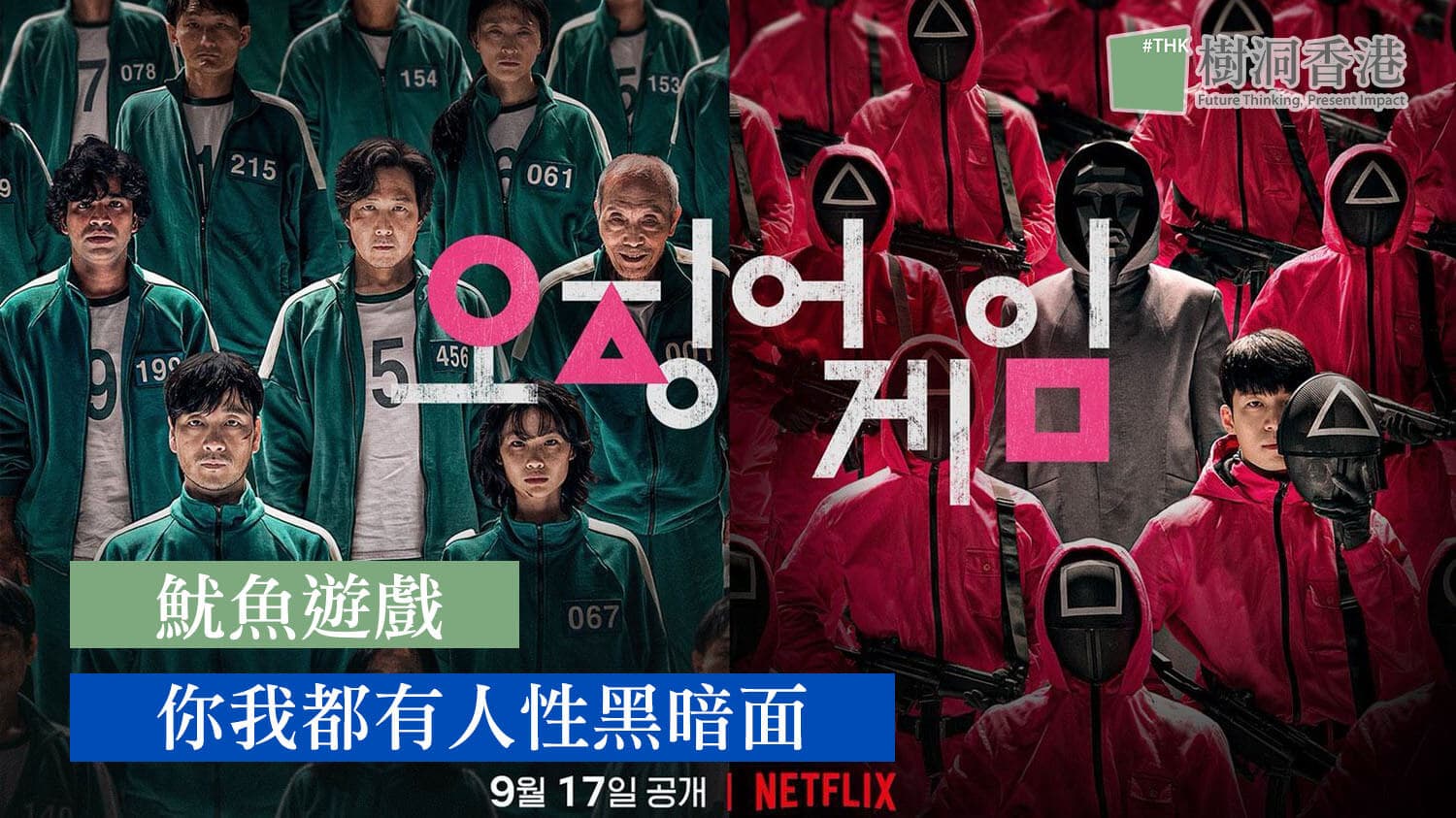
Squid Game is a drama series that probes the dark side of the human heart. Beyond its tense, gripping plot and its rich, striking visuals, what made it a phenomenon is the way its short ten-episode story keeps turning back on itself from every angle, and how it lays bare — with brutal clarity — the weakness and malice of human nature, along with the helplessness of surviving in a capitalist society.
Every character in the show has their own story of being driven, against their will, to kill one another for money: from voluntarily returning to the game, to choosing to exploit and betray the fellow players who trusted them, to watching the billions in prize money and losing every shred of human decency — killing on sight. They seem to have no other choice, yet each seemingly trivial decision is precisely what brings them a step closer to death. Today we step into the shoes of the Squid Game players and look at their experience through the lens of psychology.
The Johari Window Johari windows
You might assume that Seong Gi-hun is wrapped in the protagonist's halo from beginning to end — forever kind, forever helping the underdog. But in the moment just before the game's outcome is decided, his childhood friend Cho Sang-woo points out that his good deeds were a hollow show of virtue, an accusation that is not without grounds.
Gi-hun is millions in debt, and the only solution he can think of is to steal his ailing mother's money to bet on the horses. When he goes to his ex-wife to raise money for his mother's medical bills, he feels humiliated and lashes out by hitting someone. In other words, here is a man who is inwardly self-reproaching and deeply loves his family, yet has no idea how to treat or communicate with the people he loves. Many people in real life face exactly the same situation. The psychological concept of the Johari Window (Johari Windows) can help us analyse these problems of self-awareness and interpersonal relationships.
The Johari Window(Johari Windows) is divided into 4 areas.
Open self: information everyone can see, including your own behaviour, attitudes, feelings, motives, thoughts and so on.
Seong Gi-hun: in the early part of the game, he is friendly and accepting towards the other players, and takes the initiative to help the underdog.
Blind self: what you cannot see in yourself, yet others perceive at a glance — in other words, your so-called blind spots, including failings a person is unaware of and cannot shake off.
Seong Gi-hun: down on his luck in real life, he avoids thinking hard, neglects his work and loses himself in gambling. Some say that in the game he only ever chooses to help the underdog when he himself holds the upper hand.
Hidden self: things only you know and others have no way of knowing — the secrets a person deliberately keeps hidden.
Seong Gi-hun: in the marbles game, in order to stay alive, he gives in to a moment of weakness and chooses to deceive the old man
Unknown self: things neither others nor you can see — for example, a person's untapped potential, or repressed memories. In younger people, this area tends to be larger.
In daily life, we can practise self-disclosure (self-disclosure) by enlarging the "open self" and shrinking the "hidden self", sincerely sharing our feelings with others; at the same time, we can experience feedback from others (feedback solicitation) by enlarging the "open self" and shrinking the "blind self". This can reduce suspicion and misunderstanding between people, and improve relationships.
Why Don't the Players Vote to Leave, Even Knowing They Might Die? End Game? –
Sunk Cost
Sunk Cost was originally an economics concept, meaning "a cost that has already been paid and cannot be recovered". Applied to psychology, the book 《The Art of Thinking》 offers a good example of sunk cost — suppose you are watching a terrible film and are itching to leave halfway through, but your wife says: "We spent 30 euros on these tickets, walking out now would be such a waste." So you keep her company through the film and end up losing both your money and your time. By economic logic, a sunk cost should not influence a decision. But in real life, in order to avoid the negative emotions that come with loss, and out of a gambler's mindset that over-trusts their own luck, the higher the initial "investment", the harder it becomes to pull out of a course of action. Back to Squid Game: in the end Cho Sang-woo actually had a chance to survive, yet he chose the prize money — partly to repay his debts, and partly because hundreds of people had already been sacrificed in the game; how could he watch the billions in prize money slip away for nothing? And does where the prize money goes really represent the value of those who were sacrificed?
People tend to underestimate risk while overestimating their expected achievements. For example, psychological surveys show that most people think they are stronger than the average person, and also believe they are better than average at judging strengths and weaknesses; experts call this phenomenon optimism bias.
( Squid Game: the psychology of reciprocity. The players are all people at the end of their rope, and it is hard to come by a place where there is food to eat and a future to look to — much like the psychological tactics used in a casino, the game's base is a garish, dazzling trap, with no windows, no doors and no clocks. With the players in a state of extreme psychological insecurity, the external visual environment shapes their risk assessment.)
Sensation Seeker

From a psychologist's point of view, the difficulty of resisting the temptation to seek stimulation is in fact an extreme expression of human nature. There is a type of person known as a sensation seeker. They pursue intense stimulation and a dramatic life. For them, only through highly dramatic experiences can they feel the full range of emotions, and only then do they feel that they truly exist.
The Dark Triad
When it comes to the psychology of those who inflict cruelty, we cannot avoid mentioning The Dark Triad.
The Dark Triad refers to 3 distinct yet interrelated negative personality traits: Narcissism, Machiavellianism and Psychopathy, proposed by psychologists Delroy Paulhus and Kevin Williams in 2002.
Narcissistic personality – lacking empathy towards others and finding criticism hard to bear, such people tend to exploit others without scruple to serve their own interests, and even belittle others.
Machiavellian personality – named after the 16th-century Italian diplomat Niccolo Machiavelli. Critics consider his work 《The Prince》 to condone cunning, deceit, selfishness and similar qualities. People with this personality are therefore described as having no moral sense, no consideration for others, and willing to use any means for the sake of power and money.
Psychopathy – people with psychopathic traits feel no remorse even when they affect or harm others, and display antisocial behaviour. They are irritable in temperament and have a strong desire for control.
Research into the Dark Triad does not deal only with extreme psychological abnormalities (such as serial killers); in fact the scope of the research can extend to the general public. The elements of the Dark Triad are in truth buried in the heart of every one of us, because everyone is, to a greater or lesser degree, a little narcissistic, a little selfish, or a little inclined to challenge society's moral norms — it is only a matter of degree.
A good drama series always invites endless reflection. Suppose Hong Kong also had its own Squid Game, and suppose you could make it all the way to the final round — would you, for the sake of gain, reveal the truest side of human nature? Just how much money is the bottom line you hold to really worth?
Reference
Luft, J.; Ingham, H. (1955). The Johari window, a graphic model of interpersonal awareness. Proceedings of the Western Training Laboratory in Group Development. Los Angeles: University of California, Los Angeles.
Paulhus, D. L., & Williams, K. M. (2002). The Dark Triad of personality: Narcissism, Machiavellianism and psychopathy. Journal of Research in Personality, 36(6), 556–563. https://doi.org/10.1016/S0092-6566(02)00505-6



Comments
No comments yet — share your thoughts.