


Whenever I think back to leading teams and working alongside colleagues, I notice how easily I kept falling into the same trap, again and again. At first I believed that as long as I built good team relationships and stayed on friendly terms with the people who reported to me, the work would simply fall into place – after all, everyone is a sensible sort, so as long as the relationships are solid, surely we’ll all be pulling towards the same goal. It was fine in the beginning, but the longer we worked together, the more I would notice a gap between a colleague’s work and what I had been hoping for. Because I didn’t want to damage the relationship, I’d let problems with their work slide. I’d also think that rather than asking a colleague to redo something, it would save time and effort just to fix the mistakes myself. Over time, my dissatisfaction with that colleague kept building. I never said it out loud, but the people around me could hardly fail to sense it. In the end the working atmosphere went into a sharp decline, and the team could no longer stay anywhere near as effective.
Only later did I realise that this whole “keep the relationship pleasant, don’t criticise directly” approach was the very thing tearing the team apart. The reason is simple. Even though I never said it aloud, when you see a colleague’s work fall short of the mark (or hear an unreasonable demand from a boss), it’s hard not to feel a flicker of resentment. Usually most people just mutter under their breath – “what a deadweight”, “your problem, sort yourself out”, “forget it, talking to them is a waste of breath” – and the chance to address the mistake quietly slips away. Because you never criticise out loud, your colleague never gets the chance to understand what you actually want. And because they don’t understand what you want, the work goes more and more off course, while the resentment keeps piling up – the mask of the nice person who never criticises eventually collapses, leaving a situation where colleagues simply resent one another.
I recently finished reading Radical Candor, which sets out four ways teams communicate at work. The very best of them is Radical Candor itself, which means: pointing out the other person’s mistakes directly and in full detail, while caring about them throughout.
The two dimensions of communication
The author, Kim Scott, argues that communication at work comes down to two main dimensions: Challenge Directly and Care Personally. The first is about whether your communication clearly conveys your criticism of the other person; this challenge should be direct and easy to understand. Don’t resort to hints, mind games or a vague “you know what I mean” in place of the actual substance of the criticism, because what is obvious to you is not necessarily obvious to everyone else. The second is about whether you care about the other person’s feelings when you challenge them – good criticism should target the work, not the person, and you should step into the shoes of the person being criticised, expressing it in a way that preserves their dignity as far as possible. Although this book is aimed at the management tier, the same principle applies just as well to how a subordinate communicates with a boss. A good subordinate needs to let the boss know when they’ve made a mistake, while not treating the boss as some unfeeling manager – just like a subordinate, a boss is flesh and blood with a need to be recognised, so the way you express things calls for just as much care.
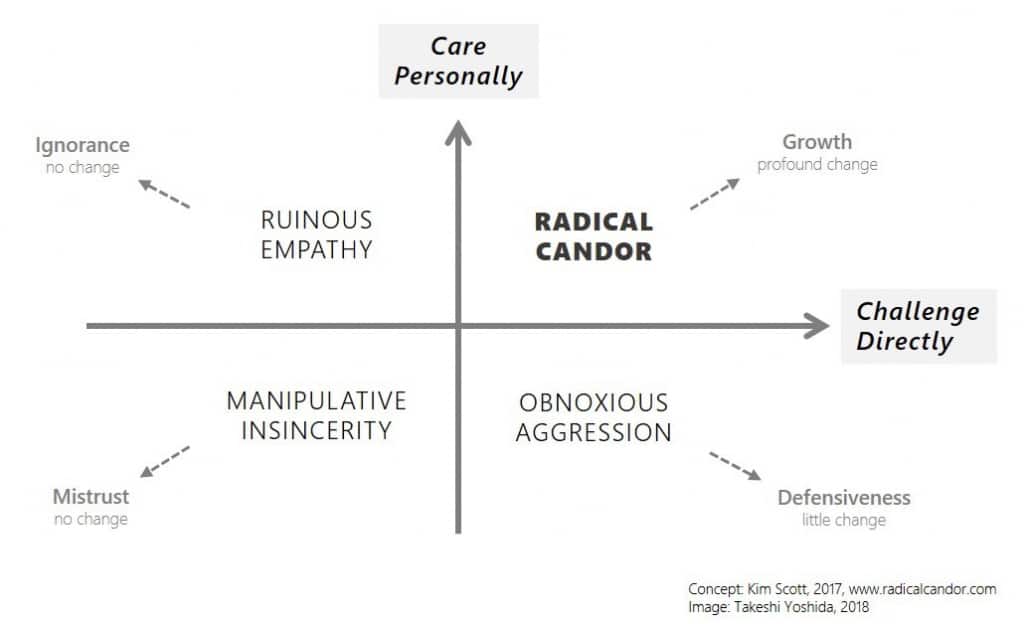
As the diagram shows, combining the two dimensions of communication gives us four communication modes, ranked here from best to worst:
1) Radical Candor – Challenge Directly, Care Personally (Radical Candor)
Example: There’s a real problem with what you’ve done. Specifically, on points A, B and C, it isn’t up to standard. I’d like to understand whether you need any support to do it better next time?
Radical candor has two benefits. First, the other person can understand directly what it is you want, which makes change possible. When, on top of the criticism, you show that you care about them and are willing to offer help, you give them the motivation to improve. One of the main reasons a person enjoys their work is the sense of making steady progress through it, and radically candid criticism lays the foundation for that growth.
Steve Jobs perhaps had a reputation for being difficult to work with as a manager; he would say flat out: “Your work is shit.” But note that what he criticised here was the work, not the person. And in Apple’s internal training guidance, he once said: “When you criticise someone, you mustn’t make them feel you’re questioning their ability, but you also can’t be wishy-washy. It really is a difficult thing to do.” (“You need to do that in a way that does not call into question your confidence in their abilities but leaves not too much room for interpretation … and that’s a hard thing to do.”)
2) Obnoxious Aggression – Challenge Directly, Don’t Care Personally (Obnoxious Aggression)
Example: Are you stupid or what? Even rubbish like this you can produce – absolutely useless!
This is also direct criticism, but it lacks any consideration of the other person’s perspective. At least they can understand the need to change, so this communication mode is better than 3) and 4). This is why an annoyingly demanding old hand often succeeds more than a nice person who lets everything slide. In the long run, though, the effectiveness can’t match 1), because obnoxious aggression doesn’t nurture any motivation in the other person to improve, so behaviourally they’ll only patch things up just enough to dodge a telling-off. And worse forms of obnoxious aggression are simply personal attacks, aimed not at the work but at the individual (as in the example), which leaves the other person with no idea what they’re even supposed to fix.
3) Ruinous Empathy – Don’t Challenge Directly, Care Personally (Ruinous Empathy)
Example: Great! Lovely! Thanks so much for all your effort this time. It’s all good (when it clearly isn’t).
Even frank, candid criticism will, to a greater or lesser degree, cause some discomfort – that’s human nature. Accepting substandard work in order to avoid that discomfort is ruinous empathy. Ruinous empathy makes the team pay a heavy price, because it leaves the other person living in the illusion that they’re doing fine. The manager’s workload keeps growing heavier, right up to the point where it becomes unbearable. As the saying goes, a long pain is worse than a short one – and it would have been better still to set the person straight from the very start.
4) Manipulative Insincerity – Don’t Challenge Directly, Don’t Care Personally (Manipulative Insincereity)
Example: … (staying silent or looking displeased, then sneering at the person behind their back to other colleagues)
This is the worst communication mode. Not only does the other person fail to understand what they’ve done wrong, with no room to improve, but the mistakes are stirred up into conflict behind their back, tearing the team apart. The motive behind this is often not for the sake of the work or the other person, but a reluctance to summon up the courage to be disliked, so the person stays silent. Thinking back, I’ve done something like this myself – if you recognise this kind of behaviour in yourself, stop right now! Whether you’re a manager or a staff member, manipulative insincerity does nothing but harm in the long run.
Treehole draws on the psychology of mindfulness to provide Team Building and communication-skills training services for businesses, teams and NGOs. For details, please see 【Treehole: Staff Training and Corporate Services, Group Activities】



Comments
No comments yet — share your thoughts.