

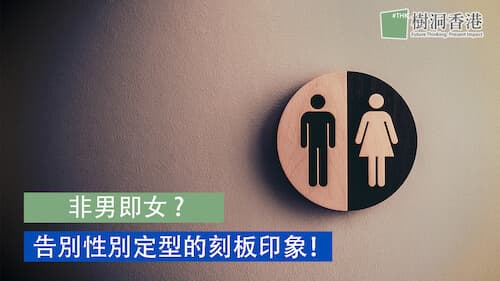
From childhood onwards, whenever we fill in a personal-details form, we run into one familiar question: sex. Most people answer it simply, defining their sex by their physical characteristics and splitting it neatly into two — that is sex typing. But is this really the most accurate way to judge it? And what, in fact, is gender?

Sex VS Gender
To answer that question, we first need to distinguish between sex and gender. Put simply, "sex" refers to one's biological sex — a reading rooted in biology and determined directly by the chromosomes. "Gender", by contrast, refers to social gender — a reading closer to psychology and culture. It is the subjective sense by which a person judges their own gender, or someone else's, from the gender characteristics they display, and can be understood as gender identity. It follows that defining gender by physical characteristics is not the only method available.
A gender role is a concept constructed by society. According to its own cultural needs, each society sets out standards and expectations for men and women at every stage of life, which is why gender roles shift with education, history, culture and an individual's own psychological development. The development of a gender role, then, is the process by which a person gradually comes to identify with the patterns of behaviour that society has laid down for the two sexes.
Sex Typing – Sex-role Stereotype
From the perspective of developmental psychology, a person's gender identity begins in early childhood and takes shape gradually as their cognitive abilities develop. Once a person becomes aware of which gender they belong to and understands the behavioural standards attached to it, they will begin to display the conduct and attitudes that fit that gender.
However, the entrenchment of gender roles has given rise to the sex-role stereotype, leaving the expression and behaviour of both sexes strictly regulated. Here is a simple question you can use to test whether you hold any gender stereotypes:

Q: Suppose you see a performer on television who looks male in physical terms (in build, voice, facial features and so on), wearing a glamorous eye look and pink lipstick, dressed in tight, sequinned shorts and a pair of four-inch heels, performing a pole dance. Your first reaction would be:
A: There's nothing unusual about it — it's their personal freedom and preference
B: I can't help reaching for my phone to film it and share this "trendy" performance with my friends
C: I can't accept it — I think the performer must be a bit off in the head to choose such an unseemly act
From A to C, everyone surely knows which answer counts as a stereotyped reaction. Beyond these more contentious scenarios, we are in fact bound by gender stereotypes every single day. We have all heard remarks like "real men don't cry", "girls shouldn't swear" or "only women like pink". The people saying them might be parents, teachers, the mass media, or even friends. Under the influence of our social environment, we have unwittingly come to hold stereotyped images of our own gender roles, overlooking the differences in each person's individual character. This easily leads to self-suppression and rigid patterns of behaviour, and in serious cases can give rise to bullying, anxiety, depression and other problems. In fact, pink was once a colour for boys back in the 18th century, and it was only gradually that society assigned it connotations of elegance and sweetness. This shows that the characteristics of gender roles are, broadly speaking, shaped by society rather than determined by biological sex.
As our understanding of gender has deepened, physical characteristics are no longer enough to define a person's gender. Beyond biological sex, there is also social gender, psychological gender and an individual's gender identity. You will find that gender is a highly multidimensional concept, and that the ways people think and behave should not be confined by a simple two-way split of the sexes. Loosening the grip of gender stereotypes, so that everyone can express their true self freely and as they please, is the most important task of all.
This article is a graduation work from the Jing Guan Certified Psychological Support Specialist programme (MBPsyS); its content or title may have been edited. The original author is Tang Chit Long.
References
Bucknell, A. (2017, 11 6). A Brief History of the Color Pink. Retrieved from Artsy: https://www.artsy.net/article/artsy-editorial-5-artists-influence-mark-rothko
Rights, E. U. (2013). EU LGBT survey – European Union lesbian, gay, bisexual and transgender survey – Results at a glance. Vienna: Publications Office of the European Union.
Wang, J. J. (2005, 10 15). Constructing new ideas of diverse gender roles and gender equality. Internet Sociology Journal, Institute of Sociology, Nanhua University, pp. 49-56. Retrieved from Institute of Sociology, Nanhua University, Internet Sociology Journal: https://mail.nhu.edu.tw/~society/e-j/49/49-56.htm

Comments
No comments yet — share your thoughts.